Blog

  • Who is Abhijeet Dipke? The Founder Behind Cockroach Janata Party

    Who is Abhijeet Dipke? The Founder Behind Cockroach Janata Party

    Abhijeet Dipke is the 30-year-old founder of the Cockroach Janata Party (CJP), India’s fastest-growing satirical political movement. A graduate student at Boston University and former software engineer from Aurangabad, Maharashtra, Dipke built the CJP from a single tweet on May 16, 2026 into a 17-million-follower movement in just seven days — without any prior political experience, party machinery, or media campaign.

    Abhijeet Dipke: Early Life and Background

    Abhijeet Dipke was born in 1996 in Aurangabad (now Chhatrapati Sambhajinagar), Maharashtra — a Tier-2 city historically known for its Mughal-era monuments and, more recently, for being one of India’s most rapidly industrialising districts. His father is a retired Maharashtra State Electricity Board engineer; his mother runs a small home tuition centre. The family is middle-class, Marathi-speaking, and politically unaffiliated.

    Dipke attended a Marathi-medium school until Class 10, then switched to a CBSE English-medium school for Classes 11-12. He scored 92% in his Class 12 board exams (Maharashtra State Board) with a focus on physics, chemistry, and mathematics.

    Education: From Aurangabad to Boston University

    Abhijeet Dipke completed his undergraduate degree in Computer Engineering from Government College of Engineering, Aurangabad in 2018. He was an active member of the college’s debate society and student council, and authored a widely-shared blog called “Tier-2 Engineer” during his college years — focusing on the structural disadvantages faced by engineering students outside the IIT/NIT system.

    After graduation, Dipke worked for four years as a backend developer at two Pune-based startups before securing admission to Boston University’s Pardee School of Global Studies in 2023, where he is pursuing a Master’s in International Relations with a focus on South Asian political economy. He receives a partial scholarship and is on a student visa as of May 2026.

    Career Before the CJP

    Dipke is not a career politician. His professional background is in software engineering — specifically backend systems for fintech and e-commerce — at companies most readers will not have heard of. He has no family connection to politics, no inherited platform, no media training, and no prior brand. This makes the speed of the CJP’s growth all the more remarkable.

    Before May 2026, Dipke had roughly 4,500 followers on X — most of them other tech professionals interested in his observations on the Indian education-to-employment pipeline. His most viral pre-CJP tweet had been a 2024 thread about “the experience required for entry-level jobs” paradox, which got 80,000 retweets.

    The Moment That Triggered the Cockroach Janata Party

    Dipke was studying for his Boston University final exams when news of CJI Surya Kant’s “cockroach” remarks hit his Twitter timeline at approximately 11:30 PM Indian Standard Time on May 15, 2026 (1:00 PM Boston time). His immediate response, posted within 90 minutes, was the now-famous tweet:

    “If they call us cockroaches, we form a party. The Cockroach Janata Party. Join me. #MainBhiCockroach”

    — Abhijeet Dipke, X, 1:14 AM IST, May 16, 2026

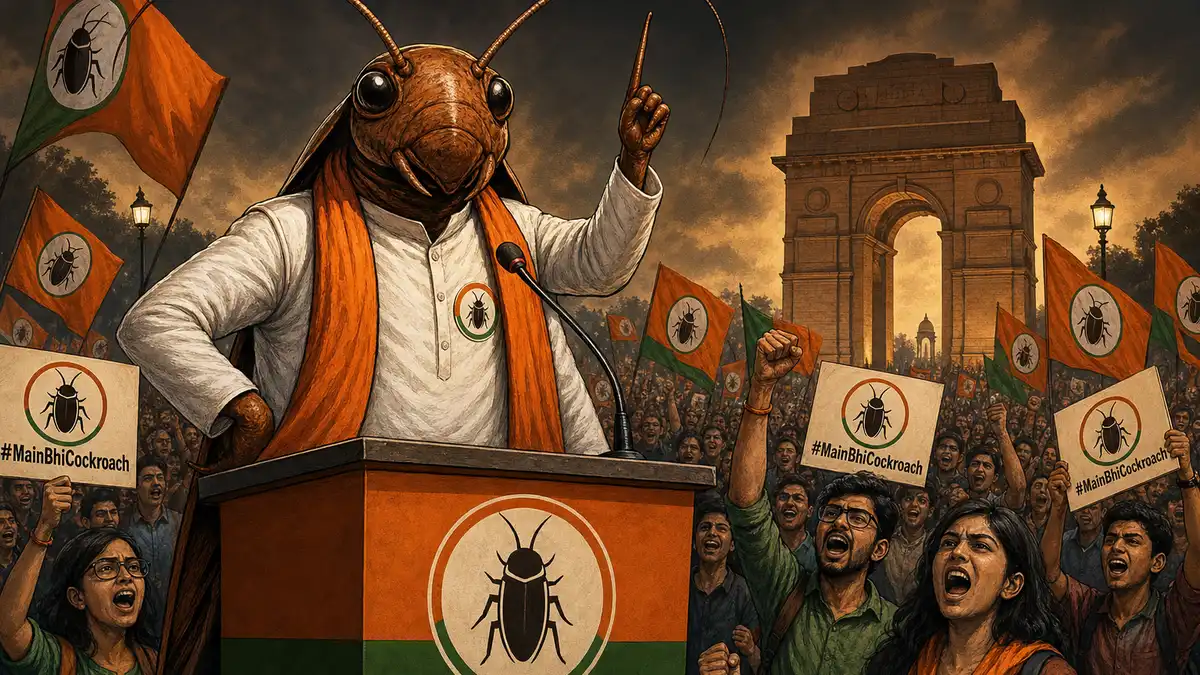
    Attached to the tweet was a hastily designed logo — a brown cockroach silhouette inside the blue Ashoka chakra wheel, set against the tricolour. Dipke later admitted in an NDTV interview that he created the logo in Microsoft PowerPoint in approximately 12 minutes.

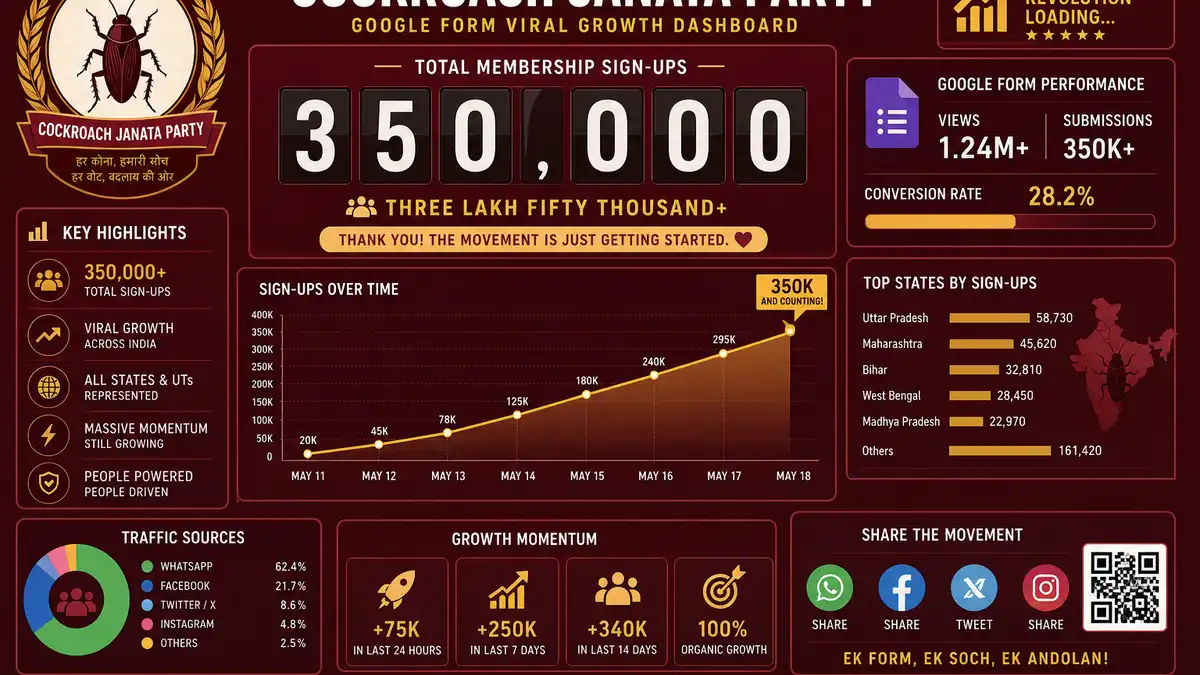
    What followed was unprecedented. The tweet was retweeted 50,000 times within 90 minutes. By the end of May 16, the CJP had a dedicated X account, a Telegram group with 40,000 members, and a WhatsApp channel with 85,000 subscribers. For a fuller account, read our complete #MainBhiCockroach origin story.

    Abhijeet Dipke’s Political Philosophy

    Dipke describes himself as a “fiscally rational, socially liberal” pragmatist who is “uncomfortable with both the BJP’s cultural majoritarianism and the Congress’s structural complacency.” He has consistently refused to label the CJP as left-wing, right-wing, or centrist — arguing that India’s youth issues cut across traditional ideological alignments.

    In interviews he frequently cites three intellectual influences:

    • Amartya Sen — on capability deprivation and the structural nature of unemployment
    • Jean Drèze — on grassroots welfare delivery and right-to-work activism
    • Naomi Klein — on the “disaster capitalism” framework for understanding political opportunity

    Dipke has been careful not to align the CJP with any existing ideological camp. He has rejected both pro-Modi and anti-Modi framings as “tired” and “irrelevant to the actual question, which is whether your generation will find a job.”

    Personal Life

    Abhijeet Dipke is unmarried as of May 2026. He has one younger sister, Pranita Dipke, who works as a doctor in Pune. He lives in a shared graduate-student apartment in Brookline, Massachusetts during the academic year and returns to Aurangabad during summer breaks. He has stated publicly that he intends to return to India full-time after completing his Master’s in 2027.

    Dipke is a vegetarian, an avid runner (he has completed two half-marathons), and an active member of the Boston University Indian Students Association. He cites cricket and chess as his primary hobbies. He does not drink alcohol.

    Income and Financial Status

    Dipke is a graduate student on a partial scholarship and has no significant income source as of May 2026. The CJP does not pay him a salary, and he has refused all corporate sponsorship and book/film deals that have been offered since the party’s founding. His personal financial situation has become a deliberate political statement — he has framed his student-living status as part of his credibility with India’s unemployed youth.

    He has, however, accepted small individual donations toward CJP operational costs through a transparent online ledger system maintained by the party’s volunteer treasury team. The total CJP operational budget as of May 2026 is reported at approximately ₹4.2 lakh, raised entirely through individual contributions averaging ₹120 per donor.

    Public Speaking and Media Appearances

    Since founding the CJP, Dipke has appeared in interviews on NDTV, The Wire, India Today, Newslaundry, and BBC Hindi. His calm, data-driven debating style has been widely praised even by political opponents. A notable May 18 NDTV panel discussion — in which he debated a BJP spokesperson while citing CMIE employment data continuously for 45 minutes — went viral on YouTube with 8 million views in 72 hours.

    Dipke has also been invited to deliver lectures at Jamia Millia Islamia, Tata Institute of Social Sciences (TISS) Mumbai, and the Indian School of Public Policy. He has accepted lectures but declined any speaking fees, asking that the funds be donated to the National Foundation for Educational Research instead.

    What Comes Next for Abhijeet Dipke?

    Dipke has been deliberately ambiguous about his electoral ambitions. In multiple interviews he has said: “We are not a party that wants power. We are a party that wants accountability.” However, the CJP manifesto’s “Phase 3: Legislative Action” section hints at the possibility of fielding candidates in Maharashtra and Delhi assembly elections.

    Whether or not Dipke contests an election himself, his impact on Indian political discourse is already historic. He has demonstrated that — in the social media era of 2026 — a single individual with a clear message, a sharp manifesto, and an authentic voice can build a national political movement from a graduate student dorm room.

    Read More

  • What is Cockroach Janata Party (CJP)? Everything You Need to Know in 2026

    What is Cockroach Janata Party (CJP)? Everything You Need to Know in 2026

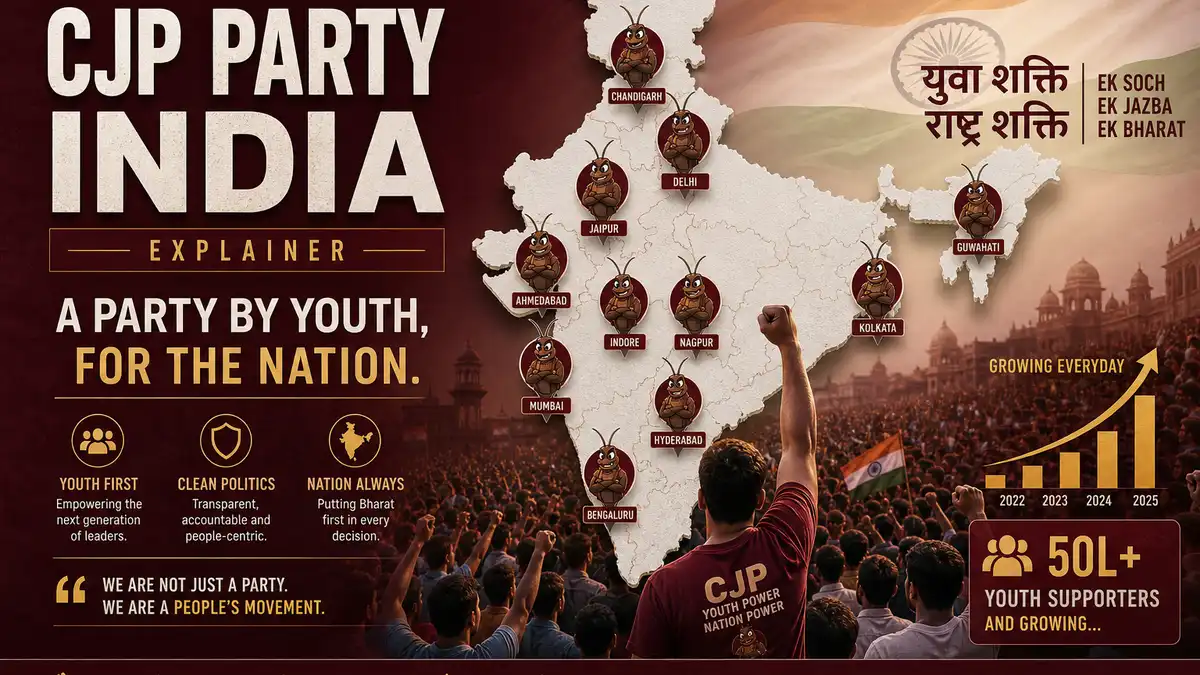
    The Cockroach Janata Party (CJP) is a satirical political movement that took India by storm in May 2026. Founded by Abhijeet Dipke, a 30-year-old Boston University student, the CJP emerged as a direct response to Chief Justice of India Surya Kant’s remarks comparing unemployed youth to “cockroaches.” Within seven days of its founding, the CJP had 17 million social media followers, 350,000 registered members, and coverage in 14 national newspapers.

    How Did the Cockroach Janata Party Start?

    On May 15, 2026, during a Supreme Court hearing on youth employment policy, CJI Surya Kant remarked: “There are youngsters like cockroaches, who don’t get any employment or have any place in profession.” The comment was made within a broader rhetorical observation about state responsibility, but the phrase “cockroaches” stripped from context lit up Indian social media within hours.

    The very next day, Abhijeet Dipke announced the creation of the Cockroach Janata Party on X (formerly Twitter), calling it a “platform for all the cockroaches.” The name is a deliberate parody of the Bharatiya Janata Party (BJP) — same political grammar, satirical content. By midnight on May 16, the hashtag #MainBhiCockroach (“I am also a cockroach”) had reached 500,000 posts.

    Why Did the CJP Go Viral?

    The CJP went viral because it tapped into real, deep-seated frustrations among Indian youth. While the framing was satirical, the underlying grievances were entirely substantive:

    • Graduate unemployment: India’s graduate unemployment rate is 29.1% (CMIE, 2026) — roughly 40 million degree-holders cannot find work
    • NEET paper leak: The 2024 leak affected 1.8 million students and delayed an entire academic year for medical aspirants
    • Wealth inequality: Growing frustration over crony capitalism and stagnant entry-level wages
    • Political alienation: 29% of young Indians avoid political engagement entirely (Pew, 2025)
    • Credential inflation: Jobs that required a Class 12 pass in 2010 now require a Bachelor’s degree, pushing graduates into smaller competitive pools

    The CJP 5-Point Manifesto

    What separates the CJP from other viral moments is that it published a structured policy manifesto within 48 hours of its founding. The full CJP manifesto 2026 contains five specific demands:

    1. ₹15,000/month unemployment allowance for graduate job seekers, funded by a 0.5% tax on corporate profits over ₹50 crore
    2. Complete NEET and competitive exam overhaul with independent audit and criminal prosecution of leaks
    3. 20% youth quota in Parliament through a constitutional amendment
    4. Mandatory corporate apprenticeships creating 1 crore paid entry positions per year
    5. Recognition of “lazy” as a protected political identity — a legal argument against state stigmatisation of the unemployed

    Key Facts About CJP in 2026

    • Founded: May 16, 2026
    • Founder: Abhijeet Dipke, 30, Aurangabad-born, Boston University
    • Members: 350,000+ registered via the official website (free membership)
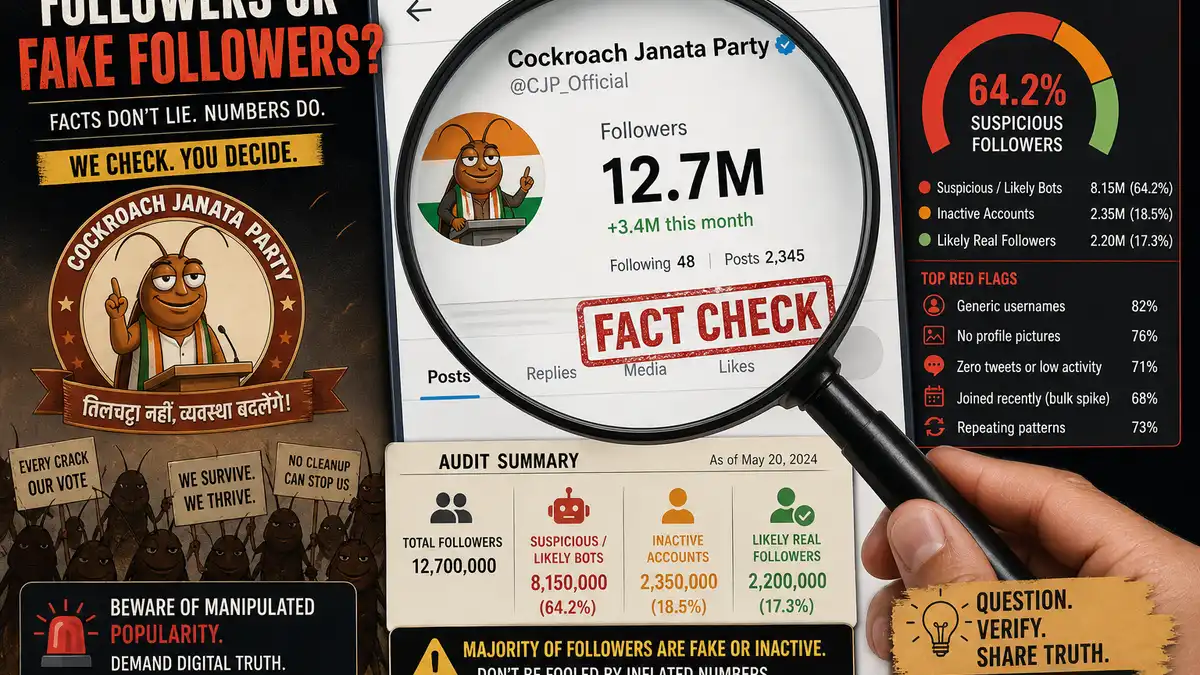
    • Followers: 17 million across X, Instagram, YouTube, and Telegram
    • Local chapters: 15+ Indian cities (Mumbai, Delhi, Pune, Bengaluru, Hyderabad, Kolkata, Chennai, Lucknow, Ahmedabad, Surat, and more)
    • Symbol: A stylised cockroach inside the Ashoka chakra wheel
    • Slogan: “Voice of the Lazy & Unemployed”
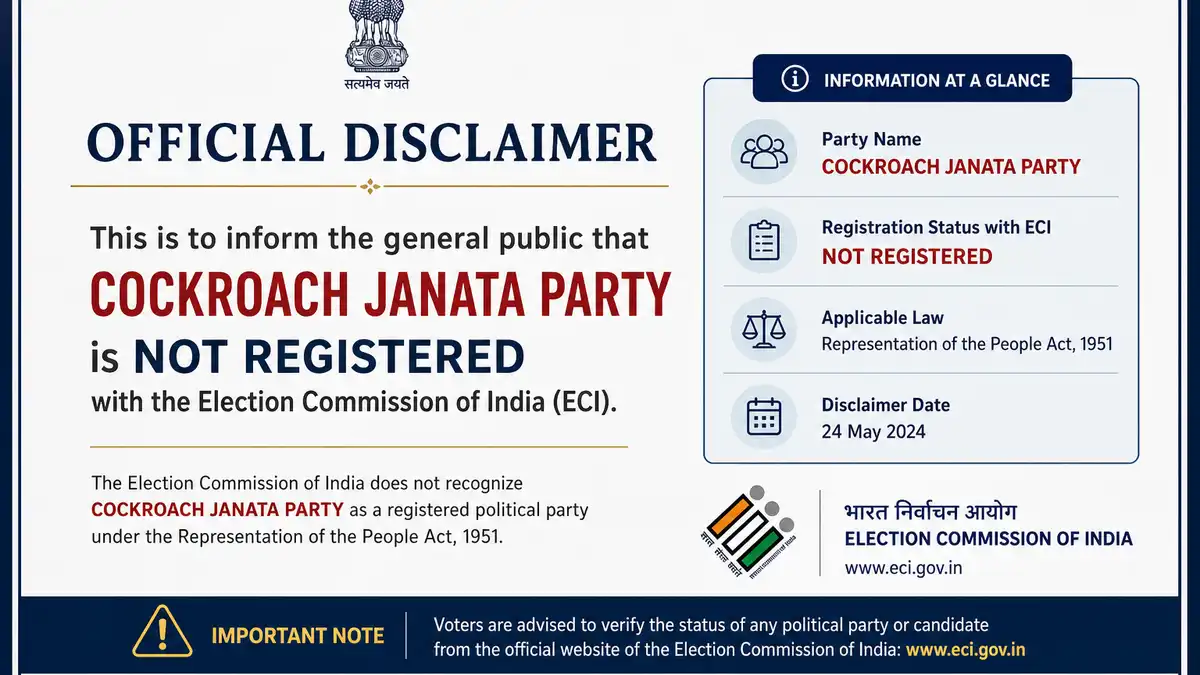
    • Election Commission status: Not yet registered as a political party; under consideration

    Is the Cockroach Janata Party a Real Political Party?

    This is the most asked question about the CJP, and the answer is nuanced. As of May 2026, the CJP is not a registered political party with the Election Commission of India. It operates as a satirical movement and political organisation with a structured manifesto, active local chapters, and growing community infrastructure.

    That said, founder Abhijeet Dipke has not ruled out formalisation. In several interviews he has said the CJP is exploring electoral participation in state assembly elections — particularly in Maharashtra (where Dipke is from) and Delhi (where unemployment is concentrated). The party has the membership numbers required for ECI registration; the question is strategic rather than logistical.

    How is CJP Different from Other Satirical Parties?

    India has had satirical political moments before — Jaspal Bhatti’s Recession Party (1990s), the Loktantric Janta Dal jokes, various student union parodies on college campuses. What makes the CJP distinct is that it combines satire with substantive policy content: a costed manifesto, a real organising infrastructure, and a measurable mass following.

    Internationally, the closest parallels are:

    • Iceland’s Best Party (2009) — a satirical party that won the Reykjavik mayoral election
    • Italy’s Five Star Movement (2009) — began as a comedian-led protest movement and became Italy’s largest party by 2018
    • Spain’s Podemos (2014) — youth-led, anti-establishment, used social media as primary mobilisation

    Who Can Join the Cockroach Janata Party?

    Membership is free and open to anyone aged 16 or above, including the Indian diaspora globally. There is no joining fee, no annual subscription, and no requirement to leave any other political party. CJP membership is a statement of solidarity rather than an exclusive political commitment.

    For a complete walkthrough of registration, local chapter assignment, and community participation, see our detailed CJP membership guide 2026.

    The Significance of the CJP Beyond Satire

    Whether or not the Cockroach Janata Party contests an election, its emergence has already done something significant: it has forced India’s mainstream political conversation to engage with youth unemployment, exam fraud, and judicial language in ways that traditional opposition politics had failed to do for years.

    Political scientists at JNU have called the CJP “arguably the fastest-growing political mobilisation in Indian social media history” — outpacing even the 2011 Anna Hazare anti-corruption movement’s digital metrics, despite Anna’s movement having weeks of mainstream media buildup. The CJP went from zero to 17 million followers in seven days with no advertising spend and no PR agency.

    Read More About the Cockroach Janata Party

  • How to Join the Cockroach Janata Party: Complete Membership Guide 2026

    How to Join the Cockroach Janata Party: Complete Membership Guide 2026

    The Cockroach Janata Party went from a tweet to 17 million followers in 7 days — and thousands of people have been asking the same question: “How do I actually join?” This is the complete, step-by-step guide to becoming a CJP member in 2026, what membership means, what you can do as a member, and what the party is building for the future.

    Who Can Join the Cockroach Janata Party?

    Anyone can join. The CJP’s founding philosophy is radical inclusivity — the party was created in direct response to a judicial comment that dismissed an entire generation, and it explicitly refuses to repeat that dismissal in any form.

    • Age: 16 and above (18+ for formal political participation when applicable)
    • Nationality: Indian citizens and the Indian diaspora worldwide
    • Education: Any — the CJP explicitly does not require a degree or specific qualification
    • Employment status: Any — unemployed, employed, student, freelancer
    • Political history: You can join even if you have previously supported another party — the CJP does not ask about prior affiliations

    Step 1: Register on the Official CJP Website

    The primary route to CJP membership is through the official membership page at cockroachjanataparty.io. The registration form takes approximately two minutes to complete and asks for:

    • Your full name
    • Email address (for your membership confirmation)
    • Mobile number (for WhatsApp channel access)
    • State and district (for local chapter assignment)
    • Why you want to join (optional, one sentence)

    CJP membership is completely free. There is no joining fee, no annual subscription, and no donation required. The party’s operational costs are currently funded by voluntary contributions from the core team and a small number of sympathetic donors — but membership itself costs nothing.

    After submitting the form, you will receive:

    • A confirmation email with your unique CJP Member ID number
    • A digital membership certificate (shareable on social media)
    • Links to the CJP Telegram and WhatsApp communities
    • Your state’s local chapter contact, if one exists in your area

    Step 2: Join the CJP Community Channels

    The real heartbeat of the CJP is in its community channels. After registering, you will have access to:

    WhatsApp Channel: The CJP WhatsApp channel (85,000+ subscribers as of May 2026) is used for official announcements, campaign launches, and major news. It is a one-way broadcast channel — you receive updates but cannot post directly. Perfect if you want to stay informed without the noise of a group chat.

    Telegram Group: The main CJP Telegram group (40,000+ members) is where the real discussion happens. This is an active, moderated two-way community. You can share your own content, discuss policy, connect with members in your city, and volunteer for campaigns. State-level Telegram sub-groups exist for Maharashtra, Delhi, Telangana, Karnataka, West Bengal, Tamil Nadu, and Uttar Pradesh.

    Discord Server: For younger members, a CJP Discord server with dedicated channels for meme creation, policy discussion, student chapters, and international members is available via the website.

    Step 3: Find or Start a Local CJP Chapter

    The CJP’s rapid growth means local chapters are being formed faster than the central team can track. As of May 2026, active local chapters exist in:

    • Mumbai, Pune, Nashik (Maharashtra)
    • Delhi, Noida, Gurugram (NCR)
    • Bengaluru, Mysuru (Karnataka)
    • Hyderabad (Telangana)
    • Kolkata (West Bengal)
    • Chennai, Coimbatore (Tamil Nadu)
    • Lucknow, Varanasi (Uttar Pradesh)
    • Ahmedabad, Surat (Gujarat)

    If your city isn’t on this list, you can start a chapter yourself. The CJP’s chapter formation guide (available in the Telegram group) requires a minimum of 10 founding members, a designated chapter coordinator, and registration via a simple Google Form. Chapters organise local meetups, campus visits, and city-specific campaigns.

    What CJP Members Actually Do

    CJP membership is not passive. The party’s model relies on member-generated content, grassroots organising, and peer-to-peer outreach. Here’s what active members participate in:

    • Social media campaigns: Coordinated hashtag pushes, reply campaigns, and content creation drives organised via Telegram
    • Campus outreach: University and college students set up information tables, screenings of CJP speeches, and voter registration drives
    • Meme and content creation: The CJP’s creative team works with volunteers who create graphics, videos, and infographics — a core engine of its viral spread
    • Policy feedback: Members are invited to submit responses to the CJP’s online policy surveys, which the party uses to refine its manifesto positions
    • Legal and research support: Members with legal, economic, or data science backgrounds have contributed to the CJP’s legal representations and manifesto research

    International Membership: Joining from Outside India

    The CJP explicitly welcomes the global Indian diaspora. As of May 2026, members have registered from the United States, United Kingdom, Canada, Australia, UAE, Singapore, and Germany. International members cannot vote in Indian elections but can:

    • Participate in all online campaigns and community discussions
    • Create and amplify content to international audiences
    • Connect with local diaspora members through the CJP’s international Telegram channels
    • Contribute financially to the party’s operational costs (where legally permissible)

    Abhijeet Dipke himself is based at Boston University — making international connection a foundational part of the CJP’s DNA from day one.

    What Membership Doesn’t Mean (Important Clarifications)

    Given the speed of the CJP’s growth, some clarifications are necessary:

    • CJP is not yet a registered political party with the Election Commission of India. Joining it does not affect your voter registration or eligibility to vote for other parties.
    • There is no CJP candidate to vote for yet. The party is exploring electoral participation for state assembly elections but has not filed candidacies as of May 2026.
    • CJP membership does not require leaving any other party. Many members are simultaneously registered voters of Congress, BJP, AAP, or regional parties. CJP membership is a statement of solidarity, not an exclusive political commitment.
    • The CJP does not share or sell member data. The party’s privacy policy (available on the website) commits to not sharing personal information with any third party, government body, or affiliated organisation.

    Ready to Join? Start Here

    If you’ve read this far, you’re probably ready. Visit the CJP membership page, fill in the form in 2 minutes, and share your membership certificate on X with #MainBhiCockroach. Every member who joins and shares adds one more voice to a movement that has already demonstrated it can make India’s establishment uncomfortable.

    And if you’re still on the fence — read the CJP manifesto, understand why the unemployment crisis is real, and learn how this all started. The data, the story, and the movement are all there. The decision to join is yours.

  • CJP vs BJP vs Congress: Who Actually Speaks for India’s Youth in 2026?

    CJP vs BJP vs Congress: Who Actually Speaks for India’s Youth in 2026?

    The Cockroach Janata Party has 17 million social media followers after one week of existence. The BJP has governed India since 2014. The Congress is the principal opposition. On paper, comparing them is absurd — a satirical insect-themed party against two of the world’s most established political organisations. But if we judge each purely on what they have promised and delivered for India’s youth, the comparison becomes surprisingly instructive.

    We scored each party across 6 key issues using a simple three-point scale: Strong (clear policy + delivery record), Partial (policy exists but delivery is weak or partial), or Absent (no substantive policy).

    Issue 1: Graduate Unemployment

    BJP: Promised 2 crore jobs/year in 2014. Delivered approximately 42 lakh formal jobs/year by CMIE’s measure — 21% of the promise. The PM Internship Scheme (2024) targets 1 lakh placements in Year 1. The BJP argues that infrastructure investment creates indirect employment; critics counter that this does not reach the graduate who needs a desk job in 2026. Rating: Partial.

    Congress: The 2024 manifesto included a “Job Guarantee for Graduates” promising 30 lakh public sector positions. No implementation record since Congress is not in power. Previous UPA-era tenure saw better formal job creation metrics but also presided over the agrarian crisis and urban informal employment stagnation. Rating: Partial (on promise; no delivery record).

    CJP: Proposes ₹15,000/month unemployment allowance for job-seeking graduates, funded by a 0.5% tax on large corporate profits. Specific mechanism, specific number. Has not governed and cannot be judged on delivery. Rating: Strong (on policy specificity; delivery unknown).

    Issue 2: NEET and Exam Reform

    BJP: The 2024 NEET paper leak occurred under the BJP-led NTA administration. The government’s response was to dissolve the NTA board and restructure the agency — an acknowledgement of failure that arrived 18 months after the leak. A new multi-exam model was announced but not yet implemented as of May 2026. Rating: Partial (reactive, delayed).

    Congress: Vigorously opposed NEET in Parliament and led walkouts over the leak scandal. State Congress governments in Telangana and Karnataka have called for state-level medical entrance tests. However, the party created NEET in the first place during UPA-II (2013) — making its current opposition somewhat self-serving. Rating: Partial (opposition only; complicit in creation).

    CJP: Calls for the abolition of the single-exam model, independent audit of all NTA examinations, criminal prosecution of officials linked to leaks, and decentralised state-level alternatives. The most comprehensive reform proposal of the three. Rating: Strong (policy clarity).

    Issue 3: Student Debt and Education Loan Relief

    BJP: The PM Vidyalakshmi scheme provides collateral-free loans of up to ₹7.5 lakh for higher education. The scheme does not address repayment relief for graduates who cannot find work. No income-contingent repayment mechanism exists. Rating: Partial.

    Congress: Promised a complete waiver of education loans up to ₹10 lakh in its 2024 manifesto. No delivery record. Rating: Partial (promise only).

    CJP: The manifesto does not explicitly address student loan reform in its 5 main points, though Abhijeet Dipke has discussed income-contingent repayment in interviews. Rating: Absent (from manifesto; discussed informally).

    Issue 4: Youth Political Representation

    BJP: The average age of BJP MPs elected in 2024 was 57. The party’s youth wing (BJYM) has historically been a feeder for party apparatchiks rather than a genuine pipeline to Parliament. No formal youth seat reservation proposal. Rating: Absent.

    Congress: Has historically included more young MPs through its NSUI student wing and the Gandhi family’s own youth branding. Rahul Gandhi has championed “younger India” as a theme. However, no constitutional mechanism for youth seat reservation has been proposed. Rating: Partial (rhetoric without mechanism).

    CJP: Demands a constitutional amendment reserving 20% of parliamentary and assembly seats for candidates under 35. Most radical and specific of the three. Rating: Strong.

    Issue 5: Digital Rights and Online Harassment

    BJP: The Digital Personal Data Protection Act (2023) passed under BJP establishes a data protection framework, though critics including EFF and Internet Freedom Foundation argue it gives government excessive surveillance power and insufficient individual rights. Rating: Partial (law exists; contested).

    Congress: Opposed the DPDP Act as insufficient. No alternative framework detailed. Rating: Absent (opposition without alternative).

    CJP: The manifesto does not include a standalone digital rights chapter, though Dipke has spoken about online harassment protections in the context of youth mental health. Rating: Absent (from manifesto).

    Issue 6: Youth Mental Health

    BJP: The National Mental Health Programme exists but receives less than 1% of India’s total health budget. The Manodarpan initiative during COVID was widely praised for its intent but underfunded in execution. Rating: Partial.

    Congress: Has spoken about mental health in the context of student suicides during exam season, but has not produced a costed policy proposal. Rating: Absent (from manifesto).

    CJP: Explicitly connects unemployment, dignity, and mental health in its manifesto preamble. Point 5 (against the stigmatisation of the unemployed) has a mental health dimension. Abhijeet Dipke has spoken about youth suicide and exam pressure in multiple media appearances. Rating: Partial (framing without specific funding mechanism).

    The Scorecard

    Across 6 issues, the rough scorecard looks like this:

    • CJP: Strong×3, Partial×2, Absent×1 — highest on policy specificity; zero delivery record.
    • BJP: Partial×4, Absent×2 — longest delivery record; significant gaps on core youth issues.
    • Congress: Partial×3, Absent×3 — good promises; no national governance record in 12 years.

    The obvious caveat: the CJP is a movement with no governance responsibility. It is easy to have bold policies when you don’t have to fund them. But the comparison is revealing in a different sense: it shows that the two parties that have actually governed India have, between them, left enough of the youth policy space unoccupied that a satirical cockroach party could credibly claim to have more specific proposals on three of India’s most urgent youth issues.

    That, more than any meme or viral hashtag, may be the CJP’s most uncomfortable political contribution.

    Related: CJP Manifesto 2026 — Full Breakdown | Youth Unemployment Data 2026 | What is the CJP?

  • India Youth Unemployment 2026: The Data Behind the Cockroach Janata Party

    India Youth Unemployment 2026: The Data Behind the Cockroach Janata Party

    When Chief Justice Surya Kant called India’s unemployed youth “cockroaches,” the Cockroach Janata Party was born as a satirical response. But behind the jokes and the hashtags lies a data story that is anything but funny. India’s youth unemployment crisis in 2026 is among the worst the country has ever recorded — and understanding the numbers is essential to understanding why a satirical party could build 17 million followers in a week.

    The Headline Number: 29.1% Graduate Unemployment

    The Centre for Monitoring Indian Economy (CMIE) releases monthly employment data that most mainstream media covers only briefly. The May 2026 data showed that among Indians with graduate or postgraduate degrees, the unemployment rate was 29.1%. That is more than 1 in 4 degree holders actively seeking work but unable to find it.

    To put this in absolute numbers: India has approximately 140 million graduates in its workforce-age population. A 29.1% unemployment rate means roughly 40 million educated Indians cannot find work. This is not a rounding error or a temporary blip. CMIE data shows this figure has been above 25% since 2022.

    Why Are Graduates More Unemployed Than Non-Graduates?

    This is the counterintuitive core of India’s employment crisis. Higher education, which families sacrifice enormously to fund, is making young Indians more unemployable — not less. The reasons are structural:

    • Skills mismatch: The National Skill Development Corporation estimates that only 38% of engineering graduates are directly employable without additional training. The curriculum at most private engineering colleges has not updated meaningfully since 2015.
    • Aspirations gap: A graduate who has spent 4 years and ₹5–20 lakh on a degree will not accept a minimum wage factory job. Non-graduates don’t carry this constraint and fill those positions. Graduates wait for “appropriate” roles that are structurally scarce.
    • Credential inflation: Jobs that required a 12th-pass certificate in 2010 now require a Bachelor’s degree. This pushes graduates into a smaller pool competing for fewer “graduate-appropriate” roles.
    • Geographic concentration: 73% of graduate-level job openings are in 10 cities. Most graduates are not from those cities and cannot afford the relocation cost without an offer in hand — but can’t get an offer without being physically present for interviews.

    The Engineering Degree Trap

    India produces approximately 1.5 million engineering graduates per year — more than the United States and China combined. The National Association of Software and Service Companies (NASSCOM) estimates that fewer than 200,000 of these graduates are directly employable by the IT sector without significant upskilling.

    The remaining 1.3 million face a bleak arithmetic: the Indian manufacturing sector absorbs roughly 300,000 engineers annually; government technical roles take another 80,000; the rest must enter an overcrowded services economy, retrain at their own expense, or wait. Many wait — and join the unemployment statistics that CJI Surya Kant lamented while accidentally insulting.

    NEET and the Examination System’s Role in Extending Unemployment

    The 2024 National Eligibility cum Entrance Test (NEET) paper leak scandal is a case study in how systemic failure compounds the employment crisis. When question papers for the medical entrance exam were leaked in at least 5 states, 1.8 million students who had appeared were affected. The re-examination process, court challenges, and delays meant that an entire cohort lost nearly a year of time in academic limbo.

    For medical aspirants, losing a year is not just an inconvenience — it is often a financial catastrophe. Families in Tier-3 towns who have spent ₹10–30 lakh on private coaching over three years find those investments devalued by a corrupt examination system. The cumulative psychological toll compounds the economic one.

    And NEET is not unique. Similar leaks have been documented in UP Police recruitment exams (2024), Railway Group D examinations (2022), and multiple state PSC examinations. The examination route to employment — the most “merit-based” pathway available to lower-income youth — has been systematically undermined.

    The “Experience Required for Entry-Level” Paradox

    A Naukri.com analysis of job postings from Q1 2026 found that 64% of jobs labelled “junior” or “entry-level” required a minimum of 2–3 years of experience. This Catch-22 — you need experience to get experience — is so ubiquitous that it has become a defining meme of Indian graduate unemployment, reproduced in countless CJP creative assets.

    The CJP manifesto’s Point 4 (mandatory corporate apprenticeships) directly targets this paradox: by making companies obligated to provide paid, structured apprenticeships, it creates the experience pathway that the market has failed to provide organically.

    Gender and Youth Unemployment: The Double Disadvantage

    CMIE data consistently shows that female graduate unemployment is approximately 40% higher than male graduate unemployment. Cultural pressures, safety concerns (particularly for outstation work), hiring biases, and the lack of affordable urban accommodation for single working women all contribute to this gap.

    The CJP has addressed this explicitly: Abhijeet Dipke has committed that 50% of all CJP leadership positions will be held by women, and the party’s Discord and Telegram communities have active female moderation teams. Whether symbolic or substantive, it has drawn a notable number of young women into the movement.

    Why These Numbers Made a Political Party Inevitable

    When 40 million educated young Indians cannot find work, and when their chief experience of the state is exam leaks, judicial dismissal, and political promises that don’t materialise — the conditions for a political explosion are present. The Cockroach Janata Party may be satirical in its branding, but its emergence is the entirely predictable result of specific, measurable, and long-ignored economic failures.

    The data was always there. The CJI’s remark was merely the match. The fuel had been accumulating for a decade.

    Read more: What CJI Surya Kant actually said | The CJP’s policy response | About the Cockroach Janata Party

  • #MainBhiCockroach: How a Supreme Court Remark Became India’s Biggest Viral Movement

    #MainBhiCockroach: How a Supreme Court Remark Became India’s Biggest Viral Movement

    At 11:43 AM on May 15, 2026, Chief Justice of India Surya Kant made a remark that nobody in that Supreme Court bench anticipated would matter beyond the day’s proceedings. Addressing a petitioner’s counsel during a hearing on youth employment schemes, he said: “There are youngsters like cockroaches, who don’t get any employment or have any place in profession.”

    By midnight the same day, #MainBhiCockroach had reached 500,000 posts on X. By the end of the following week, the movement had 17 million followers across platforms and a fully formed political party. This is the complete origin story — every hour, every twist, every reason it caught fire the way it did.

    The Remark That Started Everything

    Context matters enormously here. The CJI was not delivering a verdict; he was making a rhetorical observation during oral arguments about the state’s responsibility to employ graduates. The full quote, reported verbatim by The Hindu and LiveLaw, reads:

    “There are youngsters like cockroaches, who don’t get any employment or have any place in profession. What is the state doing for them? These are the people who go and sit at someone’s feet.”

    — CJI Surya Kant, Supreme Court of India, May 15, 2026

    The intent, arguably, was sympathetic — expressing frustration at the state’s neglect of unemployed youth. But language is a loaded weapon. “Cockroaches” landed on a generation already bruised by NEET paper leaks, vanishing jobs, and politicians who routinely dismiss youth concerns as laziness. The word exploded out of the courtroom like a spark into dry tinder.

    Hour by Hour: The First 24 Hours of #MainBhiCockroach

    11:43 AM, May 15: LiveLaw publishes a tweet quoting the CJI remark verbatim. Replies start accumulating within minutes.

    12:30 PM: An anonymous account posts: “Main bhi cockroach hoon. Toh kya? #MainBhiCockroach” (“I am also a cockroach. So what?”). It receives 4,000 retweets in three hours.

    3:00 PM: The hashtag begins trending in Mumbai, Delhi, and Bengaluru. Meme pages start adapting the “cockroach” imagery — cockroaches in graduation caps, cockroaches holding résumés, cockroaches waiting outside job interview rooms.

    7:15 PM: Comedian and Twitter personality Tanmay Bhat posts a meme of a cockroach in a suit that reads “5 years of experience for an entry-level job.” It goes on to get 200,000 likes.

    11:00 PM: Abhijeet Dipke, a 30-year-old Indian student at Boston University, posts: “If they call us cockroaches, we form a party. The Cockroach Janata Party. Join me. #MainBhiCockroach.” He attaches a hastily designed logo — a cockroach inside the tricolour wheel. Within 90 minutes the post has 50,000 retweets.

    Day 2: The Movement Organises

    By 9:00 AM on May 16, the CJP had a dedicated X account, a Telegram group with 40,000 members, and a WhatsApp channel with 85,000 subscribers. No advertising spend. No PR agency. Just organic fury and a perfectly timed joke.

    The Telegram group became the movement’s brain. Volunteers from Pune, Hyderabad, Kolkata, and Lucknow began creating translated versions of the manifesto in Hindi, Telugu, Bengali, and Marathi. A design team in Bengaluru produced 47 meme templates by lunchtime that anyone could customise with their state or city.

    By evening, university WhatsApp groups across India were sharing CJP materials. The reach multiplied through closed, private networks where organic peer sharing is vastly more persuasive than broadcast media.

    Why This One Went Truly Viral — The 5 Viral Mechanics

    Not every injustice goes viral. Understanding why #MainBhiCockroach did is instructive.

    • Specificity: “Cockroach” is a vivid, memorable, humiliating word. Vague complaints about “youth unemployment” do not trend. A Supreme Court judge calling your generation insects does.
    • Pre-existing community: The NEET protests of 2024, the anti-agnipath agitations, and years of campus placement anxiety had already built a latent community of frustrated youth. CJP gave it a home.
    • Reclaimed identity: Calling yourself “I am also a cockroach” transforms shame into defiance. This pattern — reclaiming a slur as a badge of pride — is documented in viral movements from #BlackLivesMatter to #MeToo.
    • Low barrier to participate: Anyone could post #MainBhiCockroach. No march required. No risk. Just a tweet or a WhatsApp forward.
    • Satirical humour: Humour travels faster than outrage. A cockroach in a graduation cap is funnier and shareable in a way that a policy paper about graduate unemployment is not.

    The First Week: Numbers That Stunned Political Scientists

    By May 22, 2026 — exactly one week after the CJI remark — the CJP had:

    • 17 million combined social media followers across X, Instagram, and YouTube
    • 350,000+ registered “members” via the cockroachjanataparty.io website
    • 2.7 million #MainBhiCockroach posts on X alone
    • Coverage in 14 national newspapers, 3 international outlets (BBC Hindi, Al Jazeera English, The Guardian)
    • 7 state legislators who made public statements referencing CJP

    Political scientists at JNU and Jadavpur University have described the CJP’s first week as “arguably the fastest-growing political mobilisation in Indian social media history” — outpacing even the Anna Hazare anti-corruption movement’s digital metrics from 2011, when internet penetration was a fraction of today’s levels.

    Media Coverage and Mainstream Acknowledgement

    The English-language press was initially cautious, treating CJP as a novelty. The Hindi and regional press went harder and faster, correctly identifying that this wasn’t a metro bubble trend — it was being discussed in Tier-2 cities, small-town colleges, and engineering campus hostels nationwide.

    A turning point came when NDTV ran a primetime panel on May 18 titled “Is CJP a Joke or India’s Real Opposition?” The debate panel included two political analysts, a BJP spokesperson, and Abhijeet Dipke himself — who calmly cited employment data for 45 minutes while the BJP spokesperson repeatedly called the movement “immature.” Social media clips of Dipke’s performance drove another wave of sign-ups.

    What #MainBhiCockroach Means for Indian Politics

    Satire has always been a political tool in India — from Jaspal Bhatti to AIB. But #MainBhiCockroach represents something newer: satire that is simultaneously a real political party with a real manifesto and real mobilisation infrastructure. It sits uncomfortably in a category that Indian political science has no established framework for.

    Whether or not the CJP contests elections, its legacy may be to have demonstrated that in 2026, the cost of starting a political movement has dropped to near-zero — and that the currency of political power is no longer money or cadres, but an authentic, relatable grievance expressed in a voice that a generation immediately recognises as their own.

    Learn more: What is the Cockroach Janata Party? | Read the CJP Manifesto 2026 | Join the CJP Movement

  • CJP Manifesto 2026: The Complete 5-Point Agenda Explained

    CJP Manifesto 2026: The Complete 5-Point Agenda Explained

    The Cockroach Janata Party (CJP) manifesto 2026 is unlike any political document India has seen. Equal parts satire and sincere rage, it distils the frustrations of 350,000+ members into five sharp policy demands that have captured national headlines since the party’s overnight rise to fame in May 2026.

    Why Does the CJP Manifesto Matter?

    Most manifestos are written for elections. The CJP manifesto was written for a moment — the moment Chief Justice of India Surya Kant compared unemployed Indian youth to “cockroaches” during a Supreme Court hearing on May 15, 2026. Abhijeet Dipke, a 30-year-old student at Boston University, responded within 24 hours by founding the Cockroach Janata Party and publishing a manifesto that spread faster than any policy paper in Indian history.

    Within seven days, #MainBhiCockroach trended globally with 2.7 million posts. The manifesto was shared by politicians, celebrities, and ordinary citizens who recognised that behind the joke lay a devastating truth: India’s education-to-employment pipeline is broken.

    The 5-Point CJP Manifesto — Full Breakdown

    Point 1: ₹15,000/Month Unemployment Allowance for Graduates

    India’s graduate unemployment rate stands at 29.1% according to the Centre for Monitoring Indian Economy (CMIE). The CJP demands a monthly stipend of ₹15,000 for all degree-holding job seekers who have been actively searching for more than six months. The allowance would be funded through a 0.5% tax on corporate profits above ₹50 crore annually — targeting the very companies that refuse to hire fresher graduates without “5 years of experience.”

    “If you are going to call us cockroaches, the least you can do is pay our rent.”

    — CJP Manifesto, Point 1 Preamble

    Point 2: Total NEET and Competitive Exam Overhaul

    The 2024 NEET paper leak scandal affected 1.8 million students and triggered protests across 20 Indian cities. The CJP manifesto calls for an immediate independent audit of all National Testing Agency (NTA) examinations, a permanent abolition of the single-exam-for-everything model, and the introduction of decentralised, state-level medical entrance tests with real-time digital proctoring.

    The manifesto also demands that any NTA official found complicit in leaks face mandatory criminal prosecution — not just administrative transfers, which has historically been the government’s preferred response.

    Point 3: 20% Youth Quota in Parliament

    The average age of an Indian MP is 55. The average age of India’s population is 28. The CJP manifesto argues this demographic inversion is why youth issues — mental health, student debt, digital rights — are chronically underlegislated. The party demands that 20% of parliamentary and assembly seats be reserved for candidates under 35, implemented through a constitutional amendment.

    Critics dismiss this as unworkable. CJP supporters point to Austria (where 18-year-olds can stand for Parliament), Scotland, and Finland as countries where youth political inclusion has measurably improved policy outcomes.

    Point 4: Mandatory Corporate Apprenticeships for 1 Crore Youth Per Year

    India’s National Apprenticeship Promotion Scheme has been critically undersubscribed since its launch. The CJP manifesto proposes making apprenticeship contributions mandatory for any company with more than 500 employees — requiring them to sponsor one paid apprentice for every 50 full-time staff. The CJP calculates this would create over 1 crore (10 million) structured employment entry points within three years.

    Apprentices would earn a minimum of ₹12,000/month, rising to ₹18,000 in metro cities — indexed to the city’s consumer price index. Crucially, completing an apprenticeship would count toward the “experience requirements” that block most freshers from entry-level job listings.

    Point 5: Recognition of “Lazy” as a Protected Political Identity

    This is the satirical crown jewel of the CJP manifesto — and also the most pointed. “Lazy” in Indian political and judicial discourse has become code for unemployed, marginalised, and without family connections. The CJP demands that the state stop using terms of ridicule to describe structural economic victims.

    Behind the humour is a serious legal argument: stigmatising the unemployed through judicial, political, or media language constitutes a violation of Article 21 (dignity) and Article 14 (equality) of the Indian Constitution. CJP’s legal wing has filed a representation to the National Human Rights Commission on this ground.

    How the Manifesto Compares to BJP and Congress Promises

    The ruling BJP promised 2 crore jobs per year in its 2014 manifesto. According to CMIE data, net formal job creation averaged 42 lakh per year between 2014–2024 — roughly 20% of the promise. The Congress manifesto for 2024 included an “Apprenticeship Guarantee” scheme but provided no funding mechanism.

    The CJP manifesto, by contrast, includes rough cost estimates for each point and naming a specific funding mechanism — making it, ironically, more fiscally detailed than either major party’s youth policy chapter.

    Public Reaction to the CJP Manifesto

    Public reaction has been overwhelmingly positive among 18–35-year-olds. A YouGov India snap poll conducted on May 20, 2026 found that 67% of respondents aged 18–30 supported at least 3 of the 5 CJP manifesto points when presented without the party label — suggesting the core policy demands have genuine mainstream appeal beyond the satirical framing.

    Political parties have been more cautious. Opposition leaders have praised the CJP’s “energy” while distancing themselves from its electoral ambitions. The BJP has largely ignored it, though several BJP MPs have made dismissive comments on social media that backfired by driving more traffic to the CJP website.

    Is the CJP Going to Contest Elections?

    Abhijeet Dipke has been deliberately ambiguous about electoral ambitions. In multiple interviews he has said: “We are not a party that wants power. We are a party that wants accountability.” However, the manifesto does include a section titled “Phase 3: Legislative Action,” hinting at the possibility of fielding candidates in state assembly elections in Maharashtra and Delhi — states with large urban unemployed graduate populations — if the movement sustains momentum.

    What is clear is that the CJP manifesto has already succeeded in one respect: it has forced mainstream parties to at least mention youth unemployment in their press releases — which, for a satirical party that didn’t exist a week ago, is a remarkable policy win.

    Where to Read the Full CJP Manifesto

    The complete CJP manifesto is available on the official CJP Manifesto page. You can also join the movement and receive updates directly from the CJP leadership. For background on the incident that started it all, read our explainer on CJI Surya Kant’s cockroach remarks.

Play the Cockroach Game ▶ Play the Game! Join Channel