CJP NEWSNew Delhi ·
Disclaimer: The Cockroach Janata Party (CJP) is a satirical youth movement and is not registered with the Election Commission of India (ECI). This article is for informational purposes only and does not constitute legal or electoral advice. Verify facts against primary sources (Indian Express, BBC, The Wire) and use only official links from cockroachjanataparty.io.
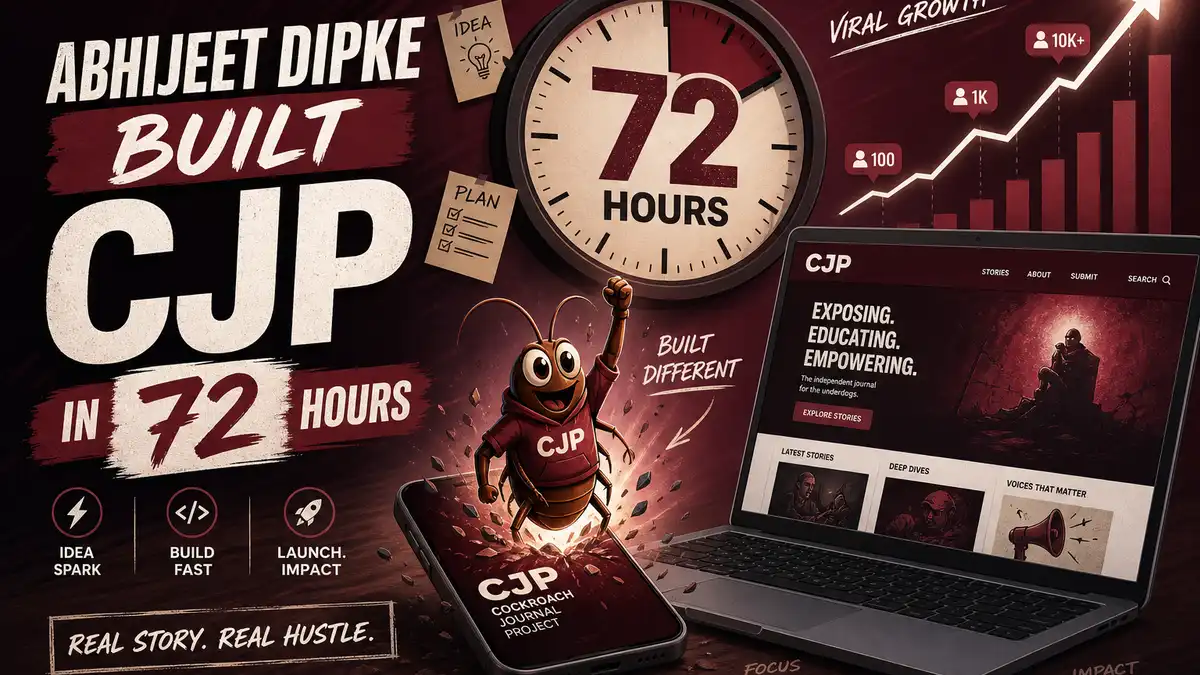
Abhijeet Dipke built CJP in 72 hours — turning a courtroom insult into one of India’s fastest-growing youth movements of 2026. The story of how a single communications strategist spun up a website, logo, manifesto and a viral brand in three days is now a case study in how AI tools and timing can collide with public anger to create a phenomenon.
This article traces who Abhijeet Dipke is, what triggered the Cockroach Janata Party, how he assembled it so quickly, and why the #MainBhiCockroach slogan resonated with millions of young Indians.
Who is Abhijeet Dipke?
Abhijeet Dipke was born on 29 September 1995 in Aurangabad (now Chhatrapati Sambhajinagar), Maharashtra. He earned a journalism degree in Pune and went on to complete a master’s in Public Relations at Boston University. His career sits squarely in political communications.
- Ex-AAP social media volunteer (2020-2023).
- Communications fellow associated with the Delhi Chief Minister’s Office.
- Advisor work with the Delhi government’s education department.
Dipke has been open about this background, but maintains that CJP is unaffiliated with any existing party. Reporting from outlets including the Times of India and the BBC has covered his profile as the movement drew national attention.
The courtroom insult that triggered CJP
The spark came on 15 May 2026, when a remark attributed to CJI Surya Kant described some unemployed youth using words like “cockroaches” and “parasites”. He later said he had been misquoted and was referring specifically to people entering jobs through fake degrees.
Regardless of the clarification, the words landed hard with a generation already anxious about unemployment. Instead of protesting the label, Dipke flipped it — reclaiming “cockroach” as a badge of resilience and birthing the slogan #MainBhiCockroach (“I too am a cockroach”).
How he built CJP in 72 hours
The defining detail of the CJP origin story is speed. Within roughly 72 hours of the remark, Dipke had assembled the entire scaffolding of a movement, leaning heavily on AI tools such as ChatGPT and Claude:
- A public website to anchor the brand and collect interest.
- A logo and visual identity built around the reclaimed cockroach symbol.
- A written manifesto framing the movement’s satirical, youth-first message.
- A Google sign-up form to capture members at scale.
This AI-assisted, solo-founder approach is exactly why the launch felt so fast and modern — a one-person communications operation doing what would normally take a full campaign team weeks.
The viral explosion
Once live, the movement’s growth was extraordinary by any standard:
- Instagram crossed 3 million followers in 78 hours.
- It passed 10 million in under five days — reportedly overtaking the BJP’s ~8.7 million.
- Followers climbed past 20 million by 22 May 2026.
- More than 350,000 people signed up to join.
The numbers turned a satirical reaction into a genuine cultural moment, and made CJP a magnet for both supporters and, unfortunately, scammers exploiting its name.
Why #MainBhiCockroach struck a nerve
The slogan #MainBhiCockroach — “I too am a cockroach” — did a lot of quiet work. Instead of arguing against the insult, it absorbed it and turned it into a shared identity. For young Indians worried about jobs and feeling talked down to, “cockroach” became a wink: resilient, impossible to get rid of, surviving against the odds. That reframing is classic communications craft, and it is exactly the kind of move you would expect from someone with Dipke’s PR training.
The hashtag gave the movement a low-friction action anyone could take: post it, claim it, belong. That is part of why the follower counts climbed so steeply — joining cost nothing and signalled solidarity in a single tap.
A case study in AI-era movement building
Beyond the politics, the CJP launch is a template for how movements may form in 2026 and beyond. A single person, equipped with AI tools and a clear sense of timing, compressed work that once required agencies and weeks into roughly three days:
- Narrative: a ready-made grievance and a sticky, reclaimed symbol.
- Tooling: AI assistants to draft copy, structure a manifesto and shape a brand.
- Distribution: Instagram-native content built for fast sharing.
- Capture: a simple Google form to convert attention into sign-ups.
Whether one sees CJP as satire, protest or both, the speed of its assembly is the genuinely new part of the story — and a sign of how the barrier to launching a mass movement keeps falling.
What it means — and a safety note
CJP’s rise shows how quickly narrative, grievance and AI tooling can combine in 2026. It is worth being precise about what the movement is and is not: it is a satirical youth movement, and it is not registered with the Election Commission of India.
Its fame has also attracted fraud. If you want to follow or join, do it only through official channels — see our CJP WhatsApp channel guide and our fake link warning so you do not fall for impostors. Membership is free, and no one from CJP will ever ask for your OTP.
Related hub: What Is CJP · Scam Alert · Join CJP · Manifesto · Social Media
Frequently Asked Questions
Who is Abhijeet Dipke?
A 30-year-old political communications strategist and Boston University PR student from Maharashtra who founded the Cockroach Janata Party on 16 May 2026.
How did Dipke build CJP so fast?
Within ~72 hours he used AI tools to create a website, logo, manifesto and a Google sign-up form, and the movement went viral on Instagram.
Was Abhijeet Dipke linked to AAP?
Yes, he volunteered with AAP’s social media team (2020-2023) and worked with the Delhi government’s education department, but says CJP is unaffiliated.
Disclaimer: The views and opinions expressed in this article are those of the author and do not necessarily reflect the official position of any political party or organisation. Readers are encouraged to independently verify all claims. Read our full Disclaimer · Terms & Conditions · Privacy Policy
