
CJP NEWSNew Delhi ·
CJP NEWS · NEW DELHI · October 13, 2026
Updated 13 Oct 2026 · By CJP Editorial Desk
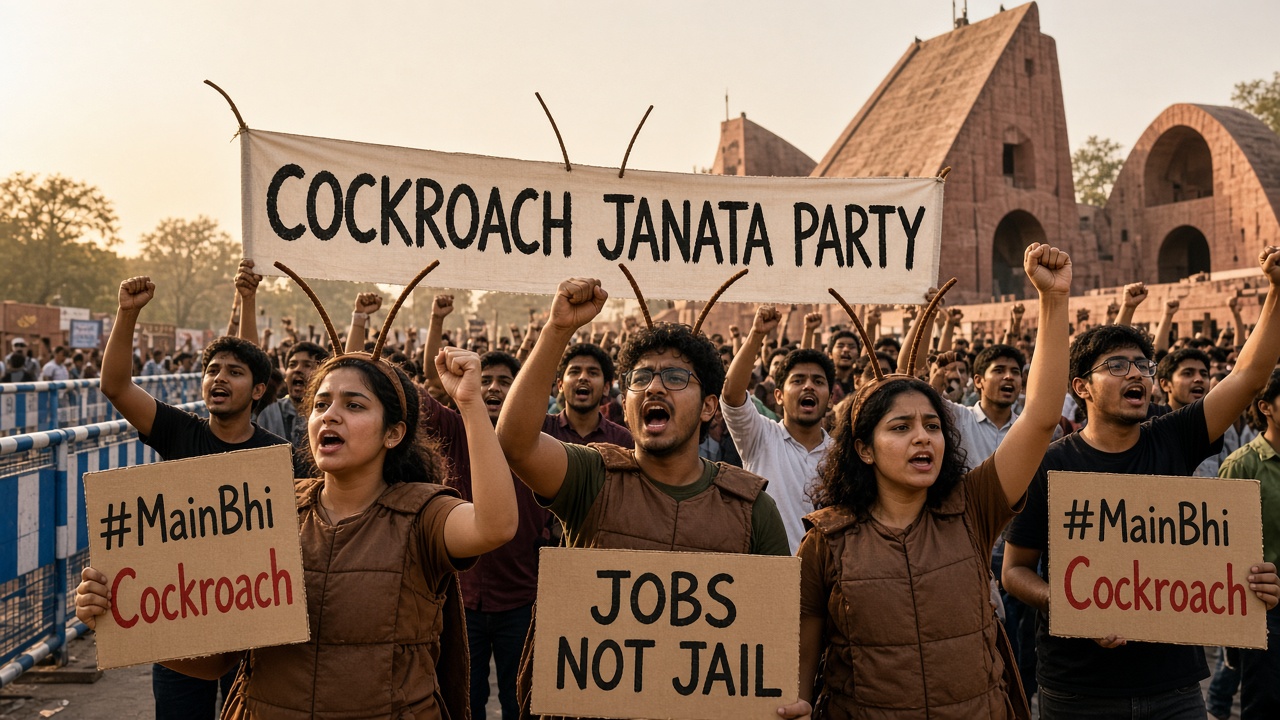
NEW DELHI — By the time the sun was fully up over Parliament Street on Sunday, the old astronomical instruments of Jantar Mantar had an unfamiliar backdrop: a few thousand young people in brown costumes, cardboard antennae bobbing over their heads, chanting a slogan that would have sounded absurd six months ago — “Main bhi cockroach, tu bhi cockroach.”
This was the biggest Cockroach Janata Party protest the capital has seen since the movement began in May, and for anyone following Jantar Mantar news this year, it was hard to miss. What started as a bitter joke about a Supreme Court remark has turned into something the organisers now openly call a “jobs rally” — and on Sunday it filled Delhi’s designated protest ground from the barricades on Parliament Street right up to the gates of the monument.
We were there from 9 a.m. Here is what actually happened, who showed up, and why this particular Sunday mattered.
How a courtroom insult ended up at Jantar Mantar
You have to go back to May to understand the costumes. On May 15, 2026, Chief Justice of India Surya Kant described unemployed youth as “cockroaches” and “parasites of society.” The line went viral within hours. The next morning, a 24-year-old organiser named Abhijeet Dipke put out a post reclaiming the insult, and the Cockroach Janata Party was born.
What followed is now reasonably well documented: more than 17 million Instagram followers in the first five days, over 350,000 registered members through online sign-up forms, and a base that is overwhelmingly young — roughly 70% of members are between 19 and 25. For a generation staring at a graduate unemployment rate of 29.1%, the cockroach became less of a slur and more of a membership card.
But followers are not footfall. Social media numbers do not prove that anyone will actually get on a train, give up a Sunday, and stand in the Delhi sun. That is the thing a physical Cockroach Janata Party protest tests, and it is the thing the party’s critics kept saying would never happen. On October 12, it happened.
What the ground looked like
The crowd did not come dressed for a funeral. There were cockroach onesies stitched by hand, antennae made from pipe cleaners and bent coat hangers, and a surprising number of parents who had clearly been dragged along and were quietly handing out water. The signs did the talking:
- “JOBS NOT JAIL”
- “#MainBhiCockroach”
- “8 million graduates a year. Where are the jobs?”
- “Call us parasites, we’ll call you unemployed” (a lot of these)
Jantar Mantar is, by design, where this sort of thing is allowed to land. Since the Boat Club and India Gate lawns were closed to agitations decades ago, the stretch of Parliament Street in front of the 18th-century observatory has been the one spot in Lutyens’ Delhi where the city’s anger is given a permit and a boundary. Farmers, teachers, wrestlers, pensioners — they have all stood here. On Sunday it was the turn of people who, legally speaking, mostly do not have jobs to take the day off from.
“They called us cockroaches to make us feel small. The joke is, cockroaches are the one thing that survives everything. We are not going anywhere.”
— A 23-year-old NET-qualified volunteer from Kanpur, speaking near the main stage
The five demands, read out loud
Around noon, organisers read out the party’s five-point manifesto from a flatbed near the barricades. For a movement that is mostly known for memes, the list on the stage was notably un-funny:
- Judicial accountability — a formal mechanism to hold constitutional authorities to account for public remarks about citizens.
- A published jobs timeline — concrete, dated targets for public-sector vacancies instead of rolling “soon” announcements.
- Clean, leak-proof exams — a direct reference to the NEET paper-leak scandal that radicalised a large chunk of this crowd.
- Women’s representation — a guaranteed share of candidate seats for women within the movement’s own structures.
- Strictly democratic, constitutional means — the clause the organisers repeat the most, because it is the one that keeps the permit valid.
That last point is not throat-clearing. It is strategy. Every CJP event so far — including the now-famous clean-up drives where members swept public spaces in full cockroach costume — has leaned hard on the optics of being orderly. Sunday was the same. No lathi charge, no detentions that we could confirm by the evening, and a visible effort by volunteers in yellow armbands to keep the crowd behind the line.
Delhi Police, barricades and the numbers game
As with every big day in the Jantar Mantar news cycle, the headline fight afterwards was about the count. Organisers claimed “over 15,000” through the day as people cycled in and out. A more conservative read of the ground — the fenced protest zone simply cannot hold six figures — puts the peak crowd in the low thousands, which is still a serious turnout for a party that is not yet six months old and has never contested an election.
Police presence was heavy but hands-off. Barricades funnelled the crowd, traffic was diverted off Parliament Street for the afternoon, and the whole thing wound down on schedule by early evening, which is exactly the outcome both sides wanted on the record.
Why this protest actually matters
It is easy to file the CJP under “internet comedy” and move on. Sunday made that harder. Three things stood out to us:
One, the online-to-offline conversion is real. A movement can rack up millions of followers and still fail the only test that counts in Indian politics — can you fill a ground? The party just answered that, in the most symbolic ground in the country.
Two, the grievance is not going away. India produces more than 8 million graduates a year into an economy that is not creating enough jobs to absorb them. You can laugh at the costumes, but the 29.1% graduate unemployment figure under them is not a punchline.
Three, the establishment keeps reacting. From the Supreme Court remark that started it, to mainstream coverage, to the recent fight over the party’s Wikipedia page, the CJP keeps forcing institutions to respond to it. A protest at Jantar Mantar is simply the physical version of that same pattern.
What happens next
Organisers told the crowd this was “the first of many” and hinted at simultaneous protests in state capitals before the end of the year. Whether the CJP can hold its discipline as it scales — and whether “strictly constitutional means” survives contact with a hundred thousand angry 22-year-olds — is the open question. For now, the party has done the one thing its doubters swore it couldn’t: it showed up, in person, and went home without a single broken window.
Frequently asked questions
What is the Cockroach Janata Party protest about?
It is a youth-led demonstration demanding jobs, clean exams, and judicial accountability. The movement started after a May 2026 Supreme Court remark calling unemployed youth “cockroaches,” and the protesters reclaimed the label with the slogan #MainBhiCockroach.
Where is Jantar Mantar and why do protests happen there?
Jantar Mantar is an 18th-century astronomical observatory on Parliament Street in central New Delhi. It is the city’s officially designated protest site, which is why it dominates Jantar Mantar news whenever a movement wants to be seen and heard in the capital.
How many people attended the CJP protest?
Organisers claimed over 15,000 across the day as crowds rotated; an independent read of the fenced protest zone puts the peak at a few thousand — a notable turnout for a party less than six months old.
Was the protest peaceful?
Yes. The event stayed within police barricades, traffic was diverted, and no detentions were confirmed by the evening. Non-violent, constitutional protest is an explicit plank of the party’s manifesto.
Is the Cockroach Janata Party a registered political party?
The CJP describes itself as a satirical political movement. It has 350,000+ registered members through online forms and has not yet contested an election, but it increasingly organises like a conventional party.
Update — October 13, 2026: This is a developing story. The CJP Editorial Desk will add verified crowd estimates, police statements, and photos from state-capital solidarity gatherings as they are confirmed.
Disclaimer: The views and opinions expressed in this article are those of the author and do not necessarily reflect the official position of any political party or organisation. Readers are encouraged to independently verify all claims. Read our full Disclaimer · Terms & Conditions · Privacy Policy
