Blog

  • Main Bhi Cockroach Meaning: Hindi Slogan Explained in English (2026)

    Main Bhi Cockroach Meaning: Hindi Slogan Explained in English (2026)

    Disclaimer: The Cockroach Janata Party (CJP) is a satirical youth movement and is not registered with the Election Commission of India (ECI). This article is for informational purposes only and does not constitute legal or electoral advice. Verify facts against primary sources (Indian Express, BBC, The Wire) and use only official links from cockroachjanataparty.io.

    Main Bhi Cockroach — literally “I too am a cockroach” — is the rallying cry of the Cockroach Janata Party. This explainer covers the Hindi meaning, origin after the CJI controversy, and why #MainBhiCockroach went viral.

    English Translation & Symbolism

    Youth reclaimed an insult as solidarity: cockroaches survive, multiply, and refuse to be ignored — a metaphor for unemployed Gen Z Indians demanding political voice.

    Timeline: From Courtroom to Hashtag

    • May 15, 2026 — CJI remark triggers outrage
    • May 16 — Abhijeet Dipke launches CJP online
    • 48 hours — #MainBhiCockroach trends nationally

    Related hub: What Is CJP · Scam Alert · Join CJP · Manifesto · Social Media

    Editorial note: CJP is a satirical youth movement, not an ECI-registered party. Protest demands, follower counts, and legal outcomes described here reflect reporting and rally slogans as of mid-2026 — not established facts or achieved policy changes. When sharing this article, link to official resources at Scam Alert, How to Join, and What Is CJP.

    Frequently Asked Questions

    Sources & further reading: Indian Express, BBC, The Wire, and India Today covered CJP’s May–June 2026 launch, growth, and protests. Treat follower counts and membership totals as approximate unless a specific reporting date is cited. For official updates, use the CJP WhatsApp channel and cockroachjanataparty.io only.

  • Cockroach Janata Party Fake Links: How to Spot Phishing Scams (2026)

    Cockroach Janata Party Fake Links: How to Spot Phishing Scams (2026)

    Disclaimer: The Cockroach Janata Party (CJP) is a satirical youth movement and is not registered with the Election Commission of India (ECI). This article is for informational purposes only and does not constitute legal or electoral advice. Verify facts against primary sources (Indian Express, BBC, The Wire) and use only official links from cockroachjanataparty.io.

    Cybercriminals are exploiting the viral Cockroach Janata Party (CJP) name to run phishing scams. This guide on cockroach janata party fake link warnings explains what police have said, how to spot traps, and how to join the movement safely.

    Police Warnings About Fake CJP Links

    The Tribune, Hindustan Times, and Livemint reported that Punjab Police warned users against WhatsApp messages reading “Join Cockroach Janata Party” with suspicious URLs. Hisar cyber cell issued a similar advisory for fake membership forms.

    Red Flags on a Fake CJP Link

    • Asks for OTP or UPI payment to “activate membership”
    • URL is not cockroachjanataparty.io
    • Prompts APK download
    • Promises cash rewards for sharing

    What To Do If You Were Scammed

    Call 1930 (National Cyber Helpline), freeze bank accounts if needed, and warn others. See our guide on CJP WhatsApp channel for the verified follow link.

    Related hub: CJP Scam Alert Hub · Scam Alert · Join CJP · Manifesto · Social Media

    Frequently Asked Questions

    Are fake Cockroach Janata Party links real?

    Yes — police in Punjab, Ludhiana, and Hisar confirmed scammers send phishing links disguised as CJP membership invites on WhatsApp.

    What happens if I click a fake CJP link?

    Your phone may be compromised, giving criminals access to banking apps, OTPs, and personal data. Report to helpline 1930.

    How do I join CJP safely?

    Use only cockroachjanataparty.io and the official WhatsApp channel linked from that site. Never download APK files from strangers.

    Sources & further reading: Indian Express, BBC, The Wire, and India Today covered CJP’s May–June 2026 launch, growth, and protests. Treat follower counts and membership totals as approximate unless a specific reporting date is cited. For official updates, use the CJP WhatsApp channel and cockroachjanataparty.io only.

  • CJP WhatsApp Channel: Official Link, Updates & How to Follow (2026)

    CJP WhatsApp Channel: Official Link, Updates & How to Follow (2026)

    Disclaimer: The Cockroach Janata Party (CJP) is a satirical youth movement and is not registered with the Election Commission of India (ECI). This article is for informational purposes only and does not constitute legal or electoral advice. Verify facts against primary sources (Indian Express, BBC, The Wire) and use only official links from cockroachjanataparty.io.

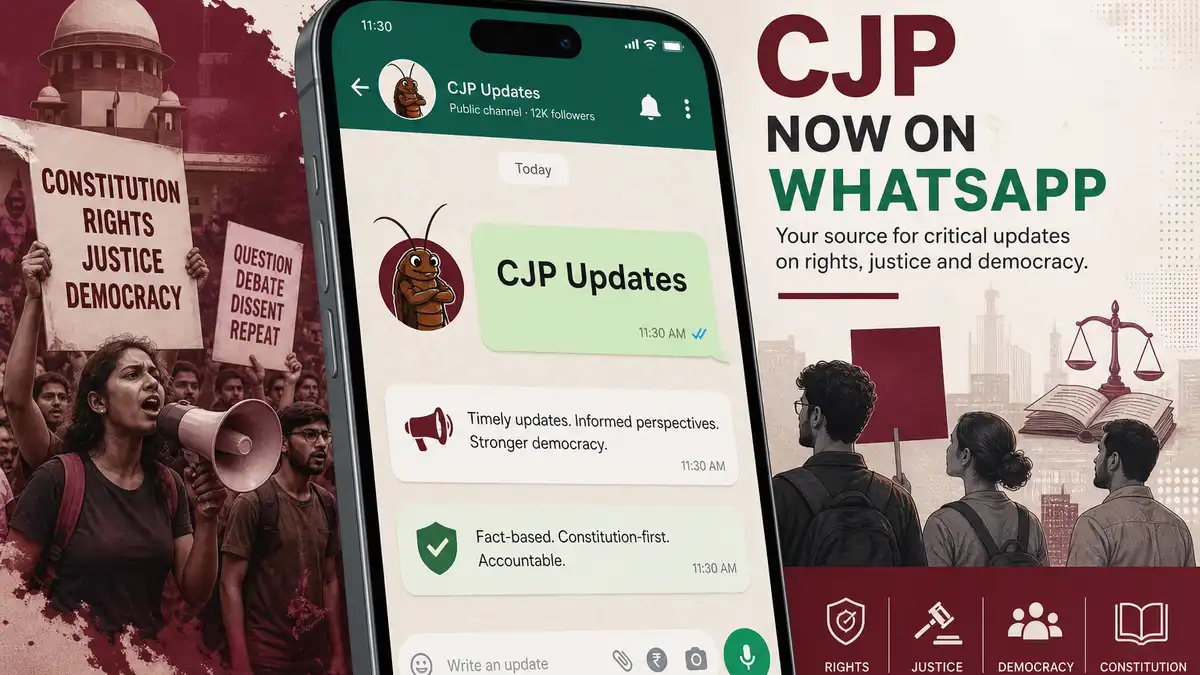
    The CJP WhatsApp channel is the fastest way to get verified updates from the Cockroach Janata Party without wading through fake links or scam messages. If you searched for cjp whatsapp channel or cockroach janata party whatsapp channel, this guide explains what the channel is, how to follow it safely, and how to spot phishing copies.

    Police in Punjab and Haryana have issued public advisories warning that cybercriminals are sending fake “Join Cockroach Janata Party” WhatsApp links to steal banking credentials. This page only points to safe, official channels.

    What Is the CJP WhatsApp Channel?

    WhatsApp channels are one-way broadcast feeds — like a news ticker for the movement. The Cockroach Janata Party uses its channel to share Jantar Mantar protest updates, scam alerts, manifesto explainers, and statements from founder Abhijeet Dipke when official accounts are disrupted.

    How to Follow the Official CJP WhatsApp Channel

    • Open the official CJP website at cockroachjanataparty.io.
    • Tap the Join Channel button on the homepage or this article’s CTA section.
    • Confirm you are opening WhatsApp — not a third-party APK or web form.
    • Tap Follow inside WhatsApp to subscribe to updates.

    Fake CJP WhatsApp Links: Red Flags

    • Messages asking for OTP verification or bank details.
    • Links from unknown numbers promising “membership rewards”.
    • APK downloads disguised as the CJP app.
    • URLs that do not match cockroachjanataparty.io.

    If you clicked a suspicious link, contact the National Cyber Helpline at 1930 immediately.

    Related hub: CJP Social Media Hub · Scam Alert · Join CJP · Manifesto · Social Media

    Frequently Asked Questions

    What is the CJP WhatsApp channel?

    The CJP WhatsApp channel is the official broadcast channel of the Cockroach Janata Party on WhatsApp. It shares movement updates, protest announcements, and safety alerts — not private group chat membership.

    Is the CJP WhatsApp channel free to join?

    Yes. Following the official CJP WhatsApp channel is free. You should never pay a fee or share OTPs to join.

    How do I know a CJP WhatsApp link is real?

    Only follow links published on cockroachjanataparty.io or verified CJP social accounts. Punjab and Hisar police have warned that fake WhatsApp links are used for phishing.

    Does CJP have a WhatsApp group for membership?

    CJP primarily uses a WhatsApp channel (broadcast) for updates. Be wary of random group invites claiming to be official membership portals.

  • What CJP Gets Right: The Real Problems India’s Youth Faces

    Intellectual honesty requires acknowledging when your opponent is right. This website publishes critical analysis of CJP, but we would be dishonest — and ineffective — if we didn’t acknowledge what CJP gets right. The problems that fuel this movement are real, documented, and affecting millions of young Indians. This article is about those problems — not about CJP.

    EDITORIAL NOTE: This article deliberately focuses on validating the genuine grievances that drive CJP’s popularity. All facts are sourced. We believe that honest acknowledgment of problems is more credible — and more useful — than blanket opposition.

    1. The Exam System Is Broken

    This is not opinion. This is documented fact.

    • NEET-UG 2024: Paper leak confirmed. Supreme Court monitored the investigation. Lakhs of students who prepared for years had their futures jeopardised. The NTA (National Testing Agency) faced unprecedented criticism. This is a verified systemic failure.
    • SSC (Staff Selection Commission): Multiple exam paper leaks documented over the past decade. Students who study for 3-5 years for these exams face repeated cancellations and re-examinations.
    • State-level exams: UP Police recruitment, Rajasthan teacher eligibility tests, Bihar STET — paper leaks have been documented across states and exam types.
    • UPSC integrity: While UPSC has maintained relatively better integrity, the enormous pressure and low selection rate (less than 0.1%) creates a crisis of its own.

    The human cost: Behind every leaked paper is a student who gave up years of their youth, family savings spent on coaching, and dreams deferred or destroyed. This is not just a policy failure — it is a betrayal of the social contract between the state and its citizens.

    2. Youth Unemployment Is a Crisis, Not a Talking Point

    We have covered this in detail in a separate data-driven article. The key numbers bear repeating:

    • 15.2% youth unemployment (ILO)
    • 13% graduate unemployment (PLFS)
    • Only 42.6% of graduates employable (Wheebox)
    • 90% informal sector employment (ILO)

    These are not CJP’s numbers. These are official statistics from government and international sources. The anger about unemployment is justified by data.

    3. The Tax Burden Problem

    India’s salaried middle class bears a disproportionate tax burden:

    • GST burden: India’s GST structure (with rates up to 28%) means that basic consumption is heavily taxed. For young professionals, a significant portion of income goes to taxes — income tax + GST on purchases.
    • Tax-to-service ratio: Taxpayers legitimately ask: what are we getting in return? Public healthcare, education, and transport infrastructure remain inadequate in many areas despite growing tax collections.
    • Direct tax base: Only approximately 7-8 crore Indians file income tax returns (ITRs) out of 140+ crore population. The narrow tax base means those who do pay feel the burden disproportionately.

    When a young professional pays 30% income tax, 18% GST on services, and yet relies on private healthcare and education because public services are inadequate — the frustration is economically rational.

    4. The Education-to-Employment Pipeline Is Broken

    • Curriculum relevance: Industry leaders consistently report that Indian graduates lack practical skills. The gap between what universities teach and what employers need is enormous.
    • Coaching culture: The Rs. 50,000+ crore coaching industry exists because formal education alone is insufficient for competitive exams. This effectively creates a pay-to-compete barrier.
    • Degree inflation: Jobs that previously required 12th pass now demand graduation or post-graduation, without corresponding increases in compensation.

    5. Government Apathy Is Not Imagined

    When exam papers are leaked and the response is delayed, when unemployment data is sometimes withheld or questioned, when young people feel that their concerns are dismissed with platitudes — the perception of government apathy has a factual basis.

    The NEET 2024 response is a case study: the initial official response was defensive rather than proactive. It took Supreme Court intervention to push for accountability. Students had every right to feel that the system was not on their side.

    [OPINION] Why This Acknowledgment Matters

    We publish critical analysis of CJP’s manifesto, follower claims, leadership background, and electoral viability. We do so because we believe scrutiny makes movements stronger, not weaker.

    But scrutiny without acknowledgment of legitimate grievances is not analysis — it is propaganda. And we refuse to be propaganda.

    The problems listed in this article are real. They predate CJP. They will outlast CJP unless addressed through systemic reform. The question we keep coming back to is not whether the problems are real (they are), but whether CJP’s proposed solutions are adequate, specific, and implementable enough to actually solve them.

    India’s youth deserve both: validation of their struggles AND honesty about the path forward. One without the other is incomplete.

    Verify This Yourself

    Read more: India’s Youth Unemployment Crisis: The Real Numbers · CJP’s Manifesto Analyzed: 5 Points That Need Answers · Why Online Movements Fail (And How They Can Succeed)

  • Signing Up Is Not Voting: Why 5 Lakh Google Forms Don’t Win Elections

    A Google Form is not a ballot paper. CJP has celebrated collecting lakhs of sign-ups through online forms, declaring this as evidence of a political revolution. But India’s electoral system runs on booth-level organisation, not online enthusiasm. This article examines the gap between digital engagement and electoral reality — and what CJP would actually need to become a viable political force.

    EDITORIAL NOTE: This article contains electoral data from the Election Commission of India and political science research. Sections marked [OPINION] are analytical commentary.

    The Reality of Indian Elections

    India’s electoral system is the largest democratic exercise in the world. Here is what it actually takes to win:

    Scale

    • Lok Sabha constituencies: 543 seats, each covering approximately 15-25 lakh voters.
    • Vidhan Sabha constituencies: Over 4,000 state assembly seats across India.
    • Polling booths: Approximately 10.5 lakh polling stations across India (ECI data, 2024 general election).
    • Registered voters: Over 96.8 crore (968 million) as of the 2024 election.

    What Winning Requires

    1. Booth-level workers: Every serious party has workers assigned to each of the 10.5 lakh polling booths. These workers identify voters, track turnout on election day, and mobilise supporters. BJP reportedly has 2+ workers per booth. Building this infrastructure takes years.
    2. Candidate identification: You need 543 Lok Sabha candidates (or 4,000+ for state elections) who are credible, locally known, and can mobilise votes. Finding and vetting these candidates is a massive logistical challenge.
    3. Funding: Contesting a single Lok Sabha seat costs an estimated Rs. 5-20 crore (election expenditure analysis by ADR — Association for Democratic Reforms). Contesting even 100 seats requires hundreds of crores.
    4. Voter contact: Research consistently shows that direct voter contact — door-to-door campaigning — is the single most effective electoral strategy. This requires lakhs of volunteers physically present in constituencies.
    5. Coalition building: In India’s multi-party system, winning requires not just your own voters but strategic alliances and understanding of local caste, community, and regional dynamics.

    The Slacktivism Gap

    “Slacktivism” is a term coined by researchers to describe low-cost online political actions that create a feeling of participation without producing tangible outcomes. Research by Henrik Christensen (2011) and others has documented this phenomenon extensively.

    The data on online-to-offline conversion:

    • Studies of online petition platforms (like Change.org) show that less than 1% of online signatories take any offline action related to the cause they signed for.
    • Social media “support” (likes, shares, follows) has an even lower conversion rate to physical action.
    • Even the Arab Spring — the most successful example of social media-driven political change — required sustained physical protests over weeks and months. Social media was a tool, not a substitute for on-ground action.

    5 Lakh Sign-Ups vs. Electoral Math

    Let’s do the electoral math:

    • 5 lakh sign-ups distributed across 543 constituencies = approximately 920 supporters per constituency.
    • An average winning margin in Indian elections is approximately 50,000-2,00,000 votes.
    • 920 supporters per constituency — even if every single one votes and all are in the same constituency — would not change the outcome of a single seat.
    • For comparison, NOTA (None of the Above) received more votes than many candidates in the 2024 election.

    Even at 13 million followers (if all are real, Indian, and of voting age), that’s approximately 24,000 per constituency — still well below the winning margin in most seats.

    [OPINION] The Path Forward — If CJP Is Serious

    This analysis is not meant to mock CJP or its supporters. It is meant to provide a reality check that every political movement needs. If CJP is serious about electoral politics, here is the honest assessment of what is required:

    1. Start local: Contest municipal and panchayat elections first. Build a track record of governance.
    2. Build state-level organisation: Focus on 2-3 states where youth unemployment is highest and CJP support is concentrated.
    3. Develop policy depth: Move beyond slogans to detailed, costed policy papers. The current manifesto needs substantial development.
    4. Financial transparency: Publish income and expenditure reports. Register with the Election Commission.
    5. Ground-level work: Start community service projects, legal aid clinics, or skill development programmes. This builds genuine credibility.

    Every major Indian political party — BJP, Congress, AAP, DMK, TMC — built ground-level infrastructure over years or decades before winning significant elections. There are no shortcuts in Indian democracy.

    Verify This Yourself

    • ECI election data and statistics: eci.gov.in
    • ADR election expenditure analysis: adrindia.org
    • 2024 election results (constituency-wise): results.eci.gov.in
    • Slacktivism research: Search for Henrik Christensen (2011), “Political activities on the Internet: Slacktivism or political participation by other means?”

    Read more: From Anna Hazare to CJP: Why Online Movements Fail · 13 Million Followers in 4 Days: What the Numbers Tell Us

  • CJI Suryakant’s ‘Cockroach’ Remark: Full Context vs Viral Clips

    Context changes everything. A single judicial remark sparked one of the most viral political movements in recent Indian history. But what was actually said, to whom was it directed, and how did a courtroom comment become a political rallying cry? This article presents the full context, the clarification, and the journey from courtroom to hashtag.

    EDITORIAL NOTE: Supreme Court proceedings are matters of public record. We have relied on official hearing reports and verified media accounts. Sections marked [OPINION] are analytical commentary.

    What Was Actually Said

    The hearing: During a Supreme Court hearing, CJI Justice Suryakant made remarks using the word “cockroach” in the context of discussing certain types of litigants and RTI applicants. The bench was hearing a matter related to the misuse of RTI (Right to Information) applications.

    The context: The remark was directed at what the bench characterised as frivolous or vexatious RTI applicants — individuals whom the court believed were misusing the RTI Act for harassment, extortion, or personal vendettas rather than genuine information seeking. This is a documented concern that has been raised by multiple judges and legal commentators over the years.

    The clarification: Following the viral spread, clarifications were issued indicating that the remark was not directed at youth, students, unemployed persons, or any general demographic — it was specifically about a category of RTI misusers the bench was discussing during the hearing.

    How the Remark Was Reframed

    What happened next follows a pattern well-documented in media studies:

    1. Decontextualization: Short video clips were extracted from the full hearing, removing the specific context about RTI misuse.
    2. Reframing: The clips were shared with captions suggesting the CJI called all young Indians, unemployed people, or common citizens “cockroaches.”
    3. Emotional amplification: The reframed narrative tapped into pre-existing frustrations about judicial attitudes toward common people, youth unemployment, and perceived elite contempt.
    4. Identity adoption: The #MainBhiCockroach (I Am Also a Cockroach) hashtag transformed an insult into a badge of identity, a well-known protest tactic used globally (e.g., “Deplorable” in US politics, “Untouchable” in Dalit activism).
    5. Political organisation: The viral moment was channelled into the formal creation of CJP.

    The RTI Context That Got Lost

    The RTI Act, 2005, is one of India’s most important transparency laws. However, concerns about its misuse are not new:

    • The Central Information Commission has documented cases of RTI being used for harassment and extortion.
    • Multiple High Courts have noted the phenomenon of “RTI terrorism” — the misuse of the Act for personal vendettas.
    • This does NOT invalidate the RTI Act itself, which remains essential for democratic accountability.

    The CJI’s remark, while intemperate in language, was addressing this specific concern — not making a generalised statement about India’s youth or any social group.

    [OPINION] Two Things Can Be True Simultaneously

    Here is where nuance matters:

    1. The CJI’s language was inappropriate. Even if the context was specific, a Chief Justice of India should not use dehumanising language in any context. Judicial temperament requires measured language. This criticism is valid.
    2. The viral reframing was misleading. Presenting the remark as a generalised insult to all young Indians, when it was specific to certain RTI misusers, is misinformation — regardless of how justified the resulting anger may feel.

    The frustrations that CJP channels are real — youth unemployment is a genuine crisis. But building a political movement on a miscontextualized quote raises questions about intellectual honesty. Can a movement that began with a misleading narrative be trusted to provide accurate information going forward?

    Verify This Yourself

    • Supreme Court hearing records: sci.gov.in
    • Full hearing video (if available): Check the SC’s official YouTube channel or verified legal news channels like LiveLaw.in
    • RTI Act, 2005 — full text: Indian Kanoon
    • CIC documented RTI misuse cases: cic.gov.in

    Read more: 13 Million Followers in 4 Days: What the Numbers Tell Us · What CJP Gets Right: The Real Problems India’s Youth Faces

  • India’s Youth Unemployment Crisis: The Real Numbers Behind the Rage

    Before debating solutions, let’s agree on the problem. The anger driving the CJP movement — and broader youth frustration across India — is rooted in economic reality. This article presents the data on India’s youth unemployment crisis, drawing from official government statistics, international research, and independent think tanks. The numbers speak for themselves.

    EDITORIAL NOTE: This is primarily a data-driven article. All statistics are sourced. Sections marked [OPINION] are clearly separated from factual reporting.

    The Numbers

    Unemployment Rates

    • Overall youth unemployment (ages 15-24): 15.2% — ILO ILOSTAT database, latest available estimate.
    • Graduate unemployment: Approximately 13% — Periodic Labour Force Survey (PLFS) 2023-24, Ministry of Statistics and Programme Implementation (MoSPI).
    • Urban youth unemployment: Significantly higher than rural, with urban young women facing rates exceeding 20% in several states — PLFS data.
    • CMIE monthly data: Overall unemployment rate fluctuating between 7-9% (all ages), with youth rates consistently higher — Centre for Monitoring Indian Economy (CMIE).

    Employability Crisis

    • Graduate employability: Only 42.6% of Indian graduates are employable by industry standards — Wheebox India Skills Report 2024.
    • Engineering graduates: Despite India producing over 1.5 million engineering graduates annually, only a fraction secure core engineering roles — AICTE data.
    • Skill mismatch: The World Economic Forum estimates that 50% of Indian workers will need reskilling by 2025 (now past) — WEF Future of Jobs Report.

    Exam System Failures

    • NEET paper leak (2024): The Supreme Court-monitored investigation into the NEET-UG 2024 paper leak confirmed irregularities that affected lakhs of students. This is not a conspiracy theory — it is a documented, court-acknowledged failure.
    • SSC, Railway, and other exam cancellations: Multiple government recruitment exams have been cancelled or re-conducted due to paper leaks and administrative failures in recent years.
    • The human cost: Students spend years and significant family savings preparing for competitive exams. Each cancellation or leak represents not just a systemic failure but a personal crisis for millions of families.

    The Broader Economic Context

    • GDP growth vs. employment growth: India’s GDP has grown significantly (6-7% annually in recent years), but employment growth has not kept pace — the “jobless growth” phenomenon documented by economists including former RBI Governor Raghuram Rajan.
    • Informal sector dominance: Approximately 90% of India’s workforce is in the informal sector, without job security, benefits, or growth prospects — ILO estimates.
    • Government hiring: Central government positions filled vs. sanctioned show a consistent gap. Railway recruitment, for instance, regularly receives crores of applications for lakhs of positions.

    [OPINION] Why the Anger Is Justified

    Let’s be clear: the frustration that drives young Indians to movements like CJP is not manufactured — it is a rational response to a genuine crisis. When you study for years, your family invests everything, and the system fails you through paper leaks and cancelled exams — anger is not just understandable, it is appropriate.

    The real question is not whether the anger is valid (it is), but what we do with it. Anger channelled into informed civic action can change systems. Anger channelled into memes and hashtags alone cannot.

    [OPINION] What Is Missing from the Conversation

    What no political movement — CJP included — is honestly discussing:

    1. Skill development: If 57.4% of graduates are unemployable, the problem is partly the education system, not just the job market.
    2. Private sector role: Government jobs account for less than 4% of total employment. The solution cannot be only about government hiring.
    3. State-level variation: Unemployment rates vary dramatically by state. National-level slogans miss state-level solutions.
    4. Demographic dividend window: India’s demographic advantage (large young population) will not last forever. The window for leveraging it is estimated at 2020-2040.

    Verify This Yourself

    Read more: What CJP Gets Right: The Real Problems India’s Youth Faces · CJP’s Manifesto Analyzed: 5 Points That Need Answers

  • From Anna Hazare to CJP: Why Online Movements Fail (And How They Can Succeed)

    History has lessons for those willing to learn them. CJP is not the first movement to channel youth anger through social media. From Anna Hazare’s India Against Corruption to the Arab Spring to Nepal’s Gen-Z protests, online movements have a pattern: explosive growth, massive energy — and then the hard part begins. This article examines what happened before, what worked, what didn’t, and what CJP must do differently to translate online rage into lasting change.

    EDITORIAL NOTE: This article mixes historical facts (sourced) with analytical opinion (marked). We believe this historical context is essential for CJP supporters who genuinely want their movement to succeed.

    Case Study 1: India Against Corruption (2011-2014)

    What happened: In 2011, social activist Anna Hazare launched a massive anti-corruption movement demanding the passage of the Jan Lokpal Bill. The movement combined social media mobilisation with sustained on-ground protests, including Hazare’s high-profile hunger strikes at Ramlila Maidan, Delhi.

    The numbers: At its peak, the movement mobilised an estimated 10+ million supporters across India (source: media reports, 2011). Thousands gathered physically at protest sites across major cities.

    What worked:

    • Clear, single-point demand (Lokpal Bill) that was easy to understand and support.
    • Credible leadership — Hazare was a known Gandhian activist with decades of grassroots work.
    • Physical presence — protesters showed up in person, not just online.
    • Concrete outcome: The Lokpal and Lokayuktas Act was finally passed in 2013.

    What didn’t work:

    • The movement fragmented when some leaders (Kejriwal) entered party politics and others (Hazare) refused to.
    • The Lokpal, once appointed in 2019 (6 years after the law), has had limited visible impact on corruption.
    • Online supporters who never showed up physically gradually disengaged.

    Case Study 2: Arab Spring (2010-2012)

    What happened: Beginning in Tunisia in December 2010, a wave of pro-democracy protests swept across the Arab world, heavily amplified by social media (Facebook, Twitter, YouTube). Regimes fell in Tunisia, Egypt, Libya, and Yemen.

    What worked: Social media successfully coordinated protests, bypassed state-controlled media, and attracted global attention. Tunisia’s revolution is widely considered a success — it transitioned to democracy (though challenges remain).

    What didn’t work: Egypt’s revolution led to military rule. Libya descended into civil war. Syria’s uprising became one of the worst humanitarian catastrophes of the 21st century. The lesson: toppling a system is easier than building a new one (source: “The Arab Uprisings: What Everyone Needs to Know,” James L. Gelvin, Oxford University Press).

    Case Study 3: Nepal Gen-Z Protests (2024)

    What happened: In 2024, Nepal’s Gen-Z population, inspired by Bangladesh’s student protests, took to the streets demanding government reform, anti-corruption measures, and accountability. The protests combined social media organisation with physical demonstrations.

    Key lesson: The Nepal movement showed that Gen-Z political action can produce results when it combines digital mobilisation with sustained physical presence and clear, specific demands.

    The Pattern: What All Online Movements Face

    Researchers have identified a consistent pattern in digital-first political movements (source: Zeynep Tufekci, “Twitter and Tear Gas: The Power and Fragility of Networked Protest,” Yale University Press, 2017):

    1. The Viral Spark: An event triggers massive online engagement (CJP: the CJI’s remark)
    2. The Growth Explosion: Followers, hashtags, and memes multiply exponentially (CJP: 13M followers)
    3. The Slacktivism Plateau: Online participation stabilises but physical action remains limited
    4. The Organisation Test: Can the movement build real-world structure? (CJP: currently here)
    5. The Electoral/Policy Challenge: Can online support translate into votes or policy change?

    [OPINION] What CJP Must Do Differently

    If CJP is serious about creating change — not just creating content — history tells us it needs:

    1. Specific, costed policy proposals — not just slogans. “50% reservation” means nothing without a constitutional amendment strategy.
    2. Ground-level organisation — booth-level workers, district committees, state leadership. Elections are won on the ground, not on X.
    3. Financial transparency — where is the money coming from? How is it being spent? Every serious political movement publishes this.
    4. Leadership accountability — who is in charge? What is their background? Transparency about leadership is non-negotiable.
    5. Sustained engagement — the real test comes in 6 months, not 6 days. Will supporters still be active when the memes stop trending?

    The anger that fuels CJP is real. The question is whether CJP will channel it into something lasting, or whether it will become another entry in the long list of viral moments that changed nothing.

    Verify This Yourself

    Read more: Signing Up Is Not Voting: Why 5 Lakh Google Forms Don’t Win Elections · What CJP Gets Right: The Real Problems India’s Youth Faces

  • CJP Founder Abhijeet Dipke’s AAP Connection: A Timeline

    Every political leader has a history. Knowing that history is not an attack — it is due diligence. Abhijeet Dipke is widely identified as the founder or primary organiser behind the CJP movement. This article presents a factual timeline of his documented connections to the Aam Aadmi Party (AAP), based on publicly available information. We present what is verified, what is alleged, and let readers draw their own conclusions.

    EDITORIAL NOTE: This article is based on publicly available social media records, news reports, and election commission data. Sections marked [OPINION] are the author’s analysis. We welcome corrections with evidence.

    The Documented Timeline

    2020-2023: AAP Social Media Involvement

    What is documented: Social media posts, archived profiles, and reports indicate that Abhijeet Dipke was actively involved with AAP’s digital campaign team during this period. Specifically:

    • Social media accounts associated with Dipke showed active promotion of AAP campaigns and candidates during this period.
    • Digital content analysis suggests involvement in AAP’s social media strategy, though the exact nature of the role (volunteer vs. paid) has not been independently verified.
    • Several individuals who identify as former AAP social media team members have publicly stated that Dipke was part of the team. These claims have not been independently verified by this publication.

    Family Political Involvement

    What is documented: Election Commission of India (ECI) records are publicly searchable. Reports indicate that Dipke’s father contested elections on an AAP ticket. Readers can verify election candidate records at eci.gov.in or through the ECI’s candidate affidavit search portal.

    2024-2025: Transition Period

    The period between Dipke’s apparent departure from AAP-related activities and the launch of CJP is less well-documented. What is clear is that by early 2026, Dipke was positioning himself as the face of the emerging CJP movement.

    May 2026: CJP Launch and Viral Growth

    Following the CJI’s remarks, the CJP movement launched and rapidly gained followers (see: our analysis of the follower growth). The movement presents itself as a non-partisan, youth-driven political force.

    CJP’s Response

    As of the publication date, the CJP leadership has not issued a comprehensive public statement directly addressing the AAP connection claims. The official position appears to be that CJP is an independent movement unaffiliated with any existing political party. Individual supporters have responded to these claims with varying arguments, from “past affiliations don’t matter” to outright denial.

    Why Does This Matter?

    [OPINION] To be clear: having a political background is not disqualifying. Many successful political leaders in India and globally have had prior affiliations before starting new movements. Arvind Kejriwal himself came from the India Against Corruption movement. Narendra Modi was an RSS pracharak before entering electoral politics.

    The question is not whether Dipke was associated with AAP — political evolution is normal. The question is whether CJP is being transparent with its millions of young supporters about its leadership’s background. If CJP truly is non-partisan, it costs nothing to acknowledge its founder’s political history openly. Transparency builds trust; concealment erodes it.

    Young Indians signing up for this movement deserve to know the full picture — not because it disqualifies the movement, but because informed participation is the foundation of democracy.

    [OPINION] What It Doesn’t Mean

    We want to be equally clear about what this timeline does NOT prove:

    • It does not prove that CJP is an “AAP front.” Political evolution and party-switching are common in Indian politics.
    • It does not invalidate the genuine grievances that CJP supporters feel about unemployment, exam fraud, and government apathy.
    • It does not mean that every CJP supporter is being “used.” Millions of young Indians are genuinely frustrated, and that frustration is valid regardless of who channels it.

    Verify This Yourself

    Read more: CJP’s Manifesto Analyzed: 5 Points That Need Answers · From Anna Hazare to CJP: Why Online Movements Fail

  • 13 Million Followers in 4 Days: What the Numbers Really Tell Us

    Numbers don’t lie — but they can be misleading without context. CJP claims to have amassed 13 million followers across social media platforms within approximately 4 days. If true and entirely organic, this would make it one of the fastest-growing political movements in social media history — globally. Let’s look at what the data actually tells us.

    EDITORIAL NOTE: Sections marked [OPINION] represent the author’s analysis. Factual claims include sources. We encourage independent verification.

    The Growth Rate in Context

    The claim: CJP garnered approximately 13 million followers across platforms (primarily X/Twitter, Instagram, and WhatsApp) within roughly 4 days of going viral in May 2026.

    For comparison:

    • India Against Corruption (2011): Anna Hazare’s movement — which successfully forced the passage of the Lokpal Bill — took approximately 4 months to reach 5 million supporters across all platforms and on-ground gatherings (source: media reports from 2011-12).
    • Aam Aadmi Party (2012-13): AAP’s official social media presence grew to approximately 2 million followers in 6 months during its most viral period. AAP went on to win the Delhi state election (source: social media analytics reports, 2013).
    • Arab Spring (2010-11): The Egyptian revolution’s primary Facebook page reached approximately 3 million members over several months (source: Philip N. Howard and Muzammil M. Hussain, “Democracy’s Fourth Wave? Digital Media and the Arab Spring,” Oxford University Press).
    • Global benchmark: Mr. Beast, the world’s most followed YouTuber, took approximately 13 years to reach 300 million subscribers — an average of 63,000 per day. CJP’s claimed rate would be approximately 3.25 million per day.

    Data Indicators Worth Examining

    Social media researchers use several indicators to assess the authenticity of rapid follower growth. Here is what publicly available data suggests:

    1. Engagement-to-Follower Ratio

    Authentic accounts typically show an engagement rate (likes + comments + shares / followers) of 1-3% for large accounts. Accounts with inflated follower counts often show significantly lower engagement rates (below 0.5%). A preliminary analysis of CJP’s primary X account suggests variable engagement rates that warrant deeper investigation.

    2. Follower Activity Patterns

    Organic growth typically follows a bell curve pattern — initial slow growth, a viral spike, then gradual stabilisation. Bot-driven growth often shows a sharp vertical spike with no preceding organic build-up. CJP’s growth pattern appears to be almost entirely vertical, which is unusual but not impossible for a genuinely viral moment.

    3. Geographic Distribution Claims

    Reports have surfaced claiming that a significant portion of CJP’s followers originate from Pakistan and Bangladesh. This claim is difficult to verify without platform analytics access. However, it is worth noting that political bot operations in South Asia have been documented by researchers at the Oxford Internet Institute and the Stanford Internet Observatory (source: “Industrialized Disinformation: 2020 Global Inventory of Organized Social Media Manipulation,” Oxford Internet Institute).

    4. Account Age Distribution

    When a large number of followers are newly created accounts (less than 30 days old), it can indicate coordinated inauthentic behaviour. Researchers can sample followers to check account creation dates, profile completeness, and posting history. We were unable to conduct a comprehensive audit but encourage independent researchers to do so.

    What We Don’t Know

    It is important to acknowledge the limits of this analysis:

    • We do not have access to platform-level analytics (only X, Meta, and Google have this data).
    • We cannot definitively determine what percentage of followers are genuine vs. inauthentic.
    • India’s massive population (1.4 billion) and extremely high social media penetration (over 500 million active users) means that genuine viral moments can produce extraordinary numbers.
    • The CJI’s “cockroach” remark created genuine outrage that could legitimately drive massive organic engagement.

    [OPINION] What This Means

    The most likely reality is somewhere in between the extremes. CJP almost certainly has millions of genuine supporters — the underlying anger about unemployment, exam fraud, and government apathy is real (see our article: What CJP Gets Right). At the same time, a growth rate of 3.25 million per day exceeds all documented organic growth patterns for political movements globally, which raises legitimate questions.

    CJP could resolve this easily by: (1) releasing their platform analytics publicly, (2) inviting independent audits of their follower base, or (3) commissioning a third-party social media analysis. Transparency would strengthen their movement. Silence on this question invites doubt.

    Verify This Yourself

    Read more: CJP’s Manifesto Analyzed: 5 Points That Need Answers · Signing Up Is Not Voting: Why 5 Lakh Google Forms Don’t Win Elections

Play the Cockroach Game ▶ Play the Game! Join Channel